


Your roof isn’t leaking, your thyroid’s fantastic, and also you’ve by no means been chased by a hungry tiger.
So why are you so exhausted, cranky, and foggy?!
We’d wish to introduce you to invisible stress.
You’re most likely acquainted with seen stress. That’s the stuff that almost all of us register as clearly traumatic—attempting to console a screaming toddler at 3:30 am, or doing a presentation in entrance of people who find themselves paid to criticize your work.
Invisible stress, however, quietly does its soiled work beneath your degree of consciousness.
When sufficient of those silent stressors add up, nevertheless, you may really feel as when you’ve simply crawled out of the lion enclosure on the zoo.
Worse, you’re left questioning: “Why am I feeling so crummy? What’s incorrect with me? Nothing dramatic occurred!”
On this article, we’ll expose 5 hidden stressors that may put on away at your well being and wellbeing.
Even higher, we’ll present you the right way to get well, so you may return to your life with extra vitality, knowledge, and resilience.
++++
Stressor #1: Info overload & filter failure
Expertise has given us many nice issues—together with an finish to {couples} combating about the necessity to ask for instructions.
One double-edged technological reward: An overabundance of knowledge.
Many people have jobs that require us to course of reams of digital fodder—within the type of emails, video calls, and chat messages.
On high of that, we frequently fill our non-work hours with extra digital materials: social media, YouTube response movies, and clicking on that advert for sneakers and falling right into a black gap of on-line purchasing.
Individuals used to name this nerve-jangling drawback info overload. However, as pc scientist and productiveness sage Cal Newport has popularized: The data itself isn’t the issue.
The actual drawback is that this: We fail to filter out the junk.
With out the ability of consciously selecting the place to position our consideration (filtering and focusing), our consideration will get yanked away from us like leaves within the wind.
Think about a busy emergency room the place no person triaged and prioritized. Stuffy noses and sprained ankles can be as essential—and randomly attended to—as somebody who’d simply been in a catastrophic automotive accident.
Thankfully, emergency personnel be taught to determine what issues most proper now and rapidly swap gears to essential priorities as wanted.
You’ll be able to be taught to do the identical.
Indicators you’re affected by this stressor
Take into account if any of the next are true for you:
✓ You’re feeling drained and edgy after spending time on the web or watching the information.
✓ You don’t spend as a lot time in your well being, health, and life targets, since you get distracted by what’s occurring on-line or with the newest Netflix launch.
✓ You retain discovering your self someplace in an info ocean, unsure how you bought there.
✓ The concept of a digital trip feels scary—however perhaps additionally a teeny bit releasing.
✓ You wrestle to know the place to place your consideration, as a result of every part’s attempting to seize it.
✓ All of it simply looks like… an excessive amount of.
Methods to get well
A focus filter lets you consciously select—with objective—the place you need to place your consideration.
To create one, you’ll first need to spend time desirous about who you might be (a.ok.a. your id) in addition to what issues to you (a.ok.a. your values).
Possibly you’re a household one who values time along with your children.
Otherwise you’re a health fanatic who cares deeply about breaking a sweat within the nice outdoor.
There aren’t any proper or incorrect solutions right here. This isn’t about what your dad and mom need for you or what you assume society desires for you.
Reasonably, it’s about what YOU need for YOU.
For assist, try our Identity, Values, and Goals chart.
And, sure, that is laborious work. If you happen to really feel misplaced attempting to determine your values, right here’s a cool strategy to determine it out. Ask your self:
What makes you indignant?
Anger could be a signal your values have been violated. The next desk lists a couple of examples.
| I received mad when… | So _________ is essential to me |
|---|---|
| Somebody lied to me | Honesty |
| I received ripped off | Equity |
| My boss requested me to work late and miss my son’s recreation | Household |
| Somebody was impolite to me | Courtesy |
As soon as you recognize your id and values, take an trustworthy have a look at the place you spend your time and vitality.
Are you placing sufficient time and vitality towards what you worth?
Heads up: Your time, vitality, and a focus will at all times be restricted.
If you say “sure” to what you worth, you’ll most likely must say “no” to one thing else.
Stressor #2: Poisonous positivity
Bear in mind these self-improvement gurus from the 90s and aughts who suggested us to “assume constructive” within the face of stress?
Whether or not you’d simply stubbed your toe or misplaced your complete household in an avalanche, the recommendation was the identical: “You’ll find a silver lining! Simply keep constructive! Every little thing occurs for a cause!”
Nonetheless, we now know contrived positivity might be counterproductive—even dangerous: When it’s not genuine, positivity can really intensify the stress we expertise.1,2
Additionally, slapping an “EVERYTHING’S FINE” label over every part can block us from recognizing issues, which stops us from fixing them.
Indicators you’re affected by this stressor
Constructive considering isn’t all unhealthy.
Take the assumption you may cope with and be taught from the various issues life throws your manner. That may show you how to really feel succesful, resourceful, and powerful, and result in development.
Poisonous positivity, nevertheless, typically results in stagnation.
You’re not transferring via challenges with braveness and vulnerability. Reasonably, you’re getting caught in “Every little thing’s okay! I don’t must cope with that as a result of it’s not an issue! I swear!”
Extra indicators that poisonous positivity is protecting you stunted:
✓ You don’t allow your self to expertise or talk about troublesome feelings resembling anger or grief.
✓ Repressed detrimental feelings appear to leak out in different methods: muscle rigidity, disappearing wine bottles, disproportionate explosions of rage when you may’t discover your keys.
✓ You’re feeling responsible or ashamed everytime you expertise a detrimental emotion like frustration or unhappiness. (“I’ve no proper to really feel this. My life is okay and so many different persons are struggling.”)
✓ You’re feeling uncomfortable when folks round you might be struggling, so that you say issues like “simply look on the brilliant aspect.”
✓ You’ve unsuccessfully began 1,000,000 gratitude journals and hated them instantly.
Methods to get well
Take note of your full vary of feelings—particularly the uncomfortable ones you would like you didn’t must expertise.
If you discover a detrimental emotion, identify it. This may be so simple as saying (out loud or inwardly): “I’m feeling indignant” or “I’m so lonely proper now.”
Discover how that feeling lives in your physique. Are you feeling stressed? Is your jaw tight? Face scorching? Tears poking at your eyes?
Be curious. Is there one thing essential or precious that the emotion is attempting to let you know? If the emotion had a voice, what would it not say? Be trustworthy with your self, not less than in your personal head.
See when you can welcome—or not less than really feel slightly softer in the direction of—the sensation as a crucial and regular life expertise that’s neither good, nor unhealthy.
Stressor #3: Your neighbor’s leaf blower
Garden tools, automotive alarms, barking canines, and different noisy goings on are extra than simply annoying.
They will set off a body-wide stress response.
In an effort to survive, we advanced to understand, interpret, and reply to the world’s cacophony of sensory info.
Based mostly on the sounds round us, your physique will perk up (say, to the sound of a crying child), jolt you into motion (to answer a blaring automotive horn), or simply do nothing (deciphering the fixed hum of the air conditioner as NBD).
We’re nicely outfitted to course of a lot of this sensory stimuli.
Nonetheless, when this info overwhelms our capacity to course of it, it turns into a stressor.
That is very true when that noise is yammering on whenever you’re attempting to complete that project your boss slammed in your inbox this morning.
Or take heed to that lecture you recognize will likely be lined on the examination.
Or, heck, simply loosen up and have some peace and quiet.
Indicators you’re affected by this stressor
Some noises are virtually universally traumatic. Suppose: the off-key teenage punk rock band that practices in a neighbor’s storage.
If the noise goes on lengthy or usually sufficient, you’ll discover signs of stress.
A few of us are unusually delicate to sensory enter.
We really feel uneasy in conditions that don’t hassle different folks—resembling a crowded restaurant with a number of competing conversations. If others round us don’t perceive or really feel the identical manner, the stress will get amplified.
You may be unusually delicate to sensory enter when you…
✓ Really feel overstimulated and/or uncomfortable in environments different folks discover stress-free or impartial (eating places, physician’s ready rooms)
✓ Keep away from sure environments (like airports and malls) since you fear you received’t have the ability to deal with all of the commotion
✓ Produce other sensory sensitivities. For instance, you reject many meals due to style or texture, or diligently rip tags off garments as a result of the little items of material torment you
Methods to get well
We want we may let you know a couple of magic swap that will flip off the world.
Fact is, some background noises are inevitable and out of our management.
However not all of them. To regain a way of management, think about two questions:
Query #1: How may you flip down the amount on sounds that set off your stress?
May you shut the blinds throughout work calls to forestall your canine from barking on the mail service?
Put on noise-cancelling headphones in crowded environments to muffle background noise?
Discuss to your neighbors about mutually-agreed upon quiet hours?
Query #2: How may you invite extra quiet?
Are there methods to construct “quiet breaks” into your day?
A few of our purchasers wish to cease at a park for 10 minutes earlier than heading dwelling after a traumatic day.
Others hand around in “sensory rooms” (restorative areas designed particularly for folks with sensory points) in airports, malls, and different locations the place these rooms can be found.
Some households schedule “quiet time” throughout which everybody might be immersed in their very own silent pursuits: coloring, studying, listening to music with headphones, or constructing Legos.
(Shhhh. That’s the sound of a pin drop.)
Stressor #4: Emotional labor
Think about you’re employed in customer support.
All day lengthy, you should fake to care deeply concerning the usually minor issues of your clients.
Even when persons are impolite or offensive, you should undertake a pleasing tone and follow the script, which partly, includes you repeatedly saying “I’m sorry” for a scenario that isn’t remotely your fault.
Nurses, therapists, coaches, and even dad and mom may relate: It doesn’t matter what form of day you’re having, you continue to attempt to appear caring and cheerful.
That’s emotional labor, a time period coined by sociologist Arlie Hochschild within the Nineteen Eighties. It’s the interior work wanted to actively handle the emotions of others, in addition to management our personal response.
And it may be as exhausting as laying bricks on a summer time day in Miami.
If we don’t account for this emotional labor, and get well from it appropriately, we threat burnout.
Indicators you’re affected by this stressor
Take into account whether or not any of the next are true for you:
✓ As a marginalized individual at work, you’re feeling you should plaster a smile to your face to be able to not provoke coworkers who make hurtful, demeaning feedback.
✓ You’re employed in a occupation that includes concealing your personal feelings and prioritizing the feelings of the client or consumer. Suppose: healthcare, regulation, customer support, social work, and also you guessed it… teaching.
✓ You’re feeling exhausted on the finish of the day since you spend most of it graciously placating cranky folks. (Hello, caregivers of young children and youngsters.)
✓ You’re the one in your family who’s at all times smoothing ruffled feathers, taking part in peacekeeper, and attempting to make sure everybody will get alongside—ignoring your personal need to inform your housemate to take a hike, your dad or mum to give up telling you the right way to reside your life, or your partner to scrub up their very own #^@%! mess.
Methods to get well
Take into account this query:
The place can you discover emotional relaxation?
Boundaries are a key tactic, particularly when you’re a high-empathy one who usually takes on others’ issues and feelings.
Deciding when—and when not—to get emotionally invested is a ability that almost all coaches (and caring folks with emotions) must work to develop.
Possibly you…
▶ Create boundaries between dwelling and work, maybe by not checking work electronic mail throughout dinner, or after a set hour.
▶ Have a essential dialog with your loved ones throughout which you clarify that you simply’re now not the United Nations for his or her infighting.
▶ Schedule 5-minute breaks into your workday so you may slam a drugs ball right into a wall, take a stroll across the block, or stare out a window.
▶ Get additional help—as an illustration, from an ally or therapist who understands your struggles.
The most effective type of emotional restoration will differ from one individual to a different.
Experiment with choices till you discover what works finest.
Stressor #5: Microaggressions
Microaggressions are small, usually refined, on a regular basis statements or actions that talk hostile, derogatory, and detrimental attitudes in the direction of somebody.
They will sound like…
| To an Asian American: | “The place are you from? I imply the place are you actually from?” |
| To an individual of shade: | Clutches their purse extra tightly. |
| To a same-sex couple with a toddler: | “So who’s the actual dad or mum?” |
| To an individual in a bigger physique: | “You’d look so good when you simply misplaced weight.” |
| To an individual who’s gender-diverse: | “Aren’t you within the incorrect lavatory?” |
| To an individual with a visual incapacity: | Will get ignored. |
To those that haven’t skilled them, microaggressions might sound too small to matter.
These are foolish little on a regular basis issues, why complain?
But microaggressions usually sting. So much. Like, “Dang, was {that a} paper lower or a scorching chainsaw??”
Although refined and, at instances, unintended, these jabs have a major impression.
They will construct over time, sporting you down and affecting the way you expertise the world.
And telling your self to “suck it up” or “I shouldn’t be bothered by this” can backfire, making the stress even worse.
Indicators you’re affected by this stressor
After years of aggregated pokes and pushes, you could:
✓ Frequently brace for impression, ready for the following shot to return
✓ Really feel exhausted. Change could really feel like one other chore to face
✓ Turn out to be suspicious of the folks round you, even when they appear to have good intentions
✓ Distrust a complete group of individuals or keep away from specific conditions
Methods to get well
There’s one vibrant spot: Micropower.
It includes taking small actions by yourself behalf to withstand the sensation of being crushed down by your circumstances.
Listed here are some examples of how somebody may uncover their micropower.
▶ Discover communities, areas, and allies who perceive particular struggles—resembling coworkers who “get it,” a help group, or a therapist who understands this specific kind of marginalization.
▶ Ask, “What do you imply by that?” and put the aggressor on the spot.
▶ Discern and prioritize: Is that this the battle you need to struggle proper now?
▶ Apply aggressive self-care. Double down on restoration and replenishing. Microaggressions might be draining.
▶ If it’s protected, name it out. Say, “That time period isn’t used any extra. Please don’t discuss with me like that.”
Or, “I’m certain you didn’t imply to suggest ____, nevertheless it got here throughout as ____. As a substitute may you please _____.”
(That is scary and has potential dangers, so construct a base of help and allies first, when you can.)
▶ You probably have the sources, construct one thing out of your expertise that advantages others.
For example, after years of experiencing stigma and discrimination, Coach Meghan Crutchley began Behavior Queer, a training and talking enterprise that makes use of the PN behavior-based strategy to help LGBTQ+ purchasers.
Even when the remainder of the scenario sucks proper now, these actions show you how to achieve essential management and empowerment.
Micropower for coaches
If you happen to’re serving purchasers from teams which have been historically marginalized or discriminated towards (resembling folks from racialized teams, current immigrants, LGBTQ+ folks, individuals who assume or be taught in a different way, folks with disabilities, and so forth), assume they’ve handled microaggressions.
As a coach, you’ll need to combine this understanding into your personal follow.
Take into account the right way to present protected, safe social help:
- Supply compassion. Attempt to empathize and perceive your purchasers’ hesitation, discomfort and nervousness. Acknowledge they could have handled innumerable social hurts that have an effect on their perceptions, engagement, and luxury inside sure areas.
- Select your phrases thoughtfully and sensitively. Small issues (like well-intentioned constructive criticism) can really feel like an assault when a consumer’s risk radar is up.
- Make the consumer the boss. Microaggressions can really feel like they take away our energy to behave and advocate. Assist purchasers really feel extra in management and protected by emphasizing their possession over their very own change course of. Assist them discover alternatives for acts of productive micropower.
Much less stress, extra restoration
If you see hidden stressors clearly, you may have a greater probability of with the ability to take empowered steps to get well from them.
Take into consideration the steadiness of stress and restoration as a tank that may be concurrently crammed (via restoration) and drained (from stress).
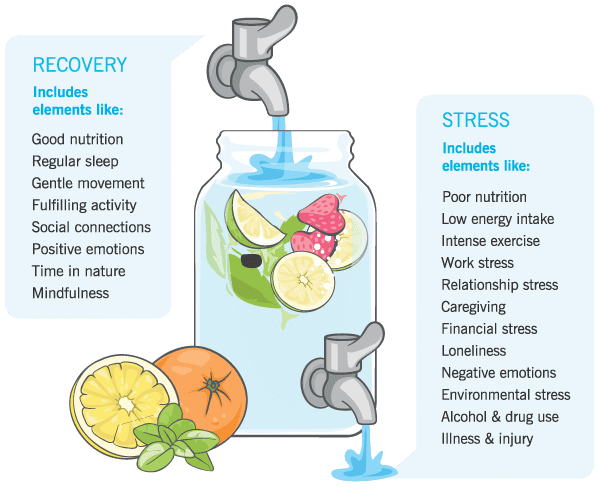
Utilizing the methods listed on this story in addition to what’s proven within the above illustration, goal to:
- Put extra within the tank by cranking up restoration practices
- Gradual or plug the leak by lowering or higher managing stress
You received’t have the ability to remove stressors—invisible or in any other case—utterly. However by slowing the leak in addition to filling the tank, you may really feel slightly extra outfitted for all times.
If you happen to’re a well being and health coach…
Studying the right way to assist purchasers handle stress, construct resilience, and optimize sleep and restoration might be deeply transformative—for each of you.
It helps purchasers get “unstuck” and makes every part else simpler—whether or not they need to eat higher, transfer extra, shed extra pounds, or reclaim their well being.
And for coaches: It provides you a rarified ability that can set you aside as an elite change maker.
PN’s brand-new certification—announcement coming quickly!—will present you the way.
Need to know extra?
References
Click on right here to view the knowledge sources referenced on this article.
