


What is Vitamin D? | How Much Do You Need? | Vitamin D and The Sun | Food Sources | Best Supplement | Deficiency | Nutrient Interactions | Vitamin D and Immunity
Vitamin D is beginning to sound, properly, too good to be true.
A whole lot of analysis research counsel that vitamin D can assist forestall all the things from osteoporosis to autoimmune issues, heart problems, and most cancers.1
Medical doctors are recommending it. Well being podcasters are speaking about it. Even your mother is nagging you about it.
With all of the hype, many individuals are questioning:
“Ought to I take vitamin D?”
We now have your solutions.
On this article, we’ll present you ways to determine if vitamin D supplementation is best for you.
You’ll be taught why it’s necessary in your well being, how a lot you want, and what to know earlier than you consider taking a vitamin D complement.
Oh, and if you’re executed studying, you possibly can ship this text to Mother. (And provides her our greatest, will you?)
What’s vitamin D?
Vitamin D is a fat-soluble vitamin that we (principally) get from the solar, but in addition from sure meals, and naturally, from dietary supplements.
And really, “vitamin D” isn’t only one single factor. Vitamin D refers to a group of compounds.
Let’s meet the household:
- Vitamin D2 (ergocalciferol) could be made by vegetation (equivalent to mushrooms) and yeasts.
- Vitamin D3 (cholecalciferol) comes from animal merchandise like fish, egg yolks, and cheese. We additionally make vitamin D3 on the floor of our pores and skin once we’re uncovered to daylight.
- Calcifediol (25-hydroxyvitamin D) is the type of vitamin D that’s measured in blood exams. It really begins out as vitamin D3, however as soon as vitamin D3 enters your bloodstream your liver converts it into calcifediol.
- Calcitriol (1,25 dihydroxyvitamin D) is probably the most metabolically energetic type of vitamin D. It’s created in your kidneys from calcifediol. Not like its precursor vitamin D3, calcitriol is not thought of a vitamin: It’s a hormone.
Whoa. A lot shape-shifting. Sneaky.
What does vitamin D do?
Current analysis means that almost each cell of our physique has receptors for vitamin D. Not surprisingly, it has wide-ranging results within the physique.
Vitamin D helps assist your:
- immune system
- cell perform
- blood sugar regulation
- bone well being
- calcium absorption and circulation
- regular blood stress
(Do you know that the majority nutritional vitamins and minerals have broad well being results? Study extra: All about vitamins and minerals.)
How do I do know if I have to complement?
For many people, supplementing with vitamin D is a good suggestion. Particularly if we fall into one of many classes of people who find themselves extra prone to have a vitamin D deficiency. (Take the quiz below to find out if that’s you.)
Nevertheless, the one approach to know for certain if we’re poor is to get a blood take a look at.
So as to optimize bone well being and decrease the chance of illness, individuals ought to intention to attain a blood stage of vitamin D of no less than 50 nmol/L (20 ng/mL).2 (The “candy spot” is perhaps nearer to round 75 nmol/L, or 30 ng/mL.)
To fulfill this goal, listed here are the urged each day vitamin D intakes (from mixed meals and complement sources), for various levels of life:
Basic suggestions for vitamin D consumption
| Age | Advisable each day vitamin D consumption |
|---|---|
| 0–12 months | 400–1000 IU/d |
| 1–18 years | 600–1000 IU/d |
| 18–70+ years | 800–2000 IU/d |
| Pregnant / breastfeeding (>18 years) | 800–2000 IU/d |
Most wholesome adults ought to have the ability to keep an satisfactory blood stage of vitamin D (50–100 nmol/L or 20-40 ng/mL) by getting about 800-1000 IU each day of vitamin D, from each meals and complement sources.
In instances of extra extreme deficiency, some individuals might have to take extra vitamin D than we’ve listed above. Work along with your medical physician to determine the correct dose for you, and the way lengthy to take it for.
How do you get vitamin D?
The perfect vitamin D supply, ever: The solar
Many individuals can meet their vitamin D necessities via sunshine alone. And so far as “pure sources of vitamin D” goes, daylight is a tippy best choice.
A superb basic guideline: Get about 10-20 minutes a day of noon solar, with face, arms, palms, and legs uncovered (and no sunscreen).
The quantity of vitamin D you get (and soak up) from the solar is determined by a bunch of issues, like geographic location, pores and skin tone, clothes type, sunscreen use, age, and total well being.
So, relying on who you might be, and the place you might be, it’s possible you’ll want extra solar than the above suggestion.
The perfect vitamin D meals sources
You’ll be able to considerably bump up your vitamin D consumption by prioritizing sure meals in your weight-reduction plan.
Listed here are among the finest sources3:
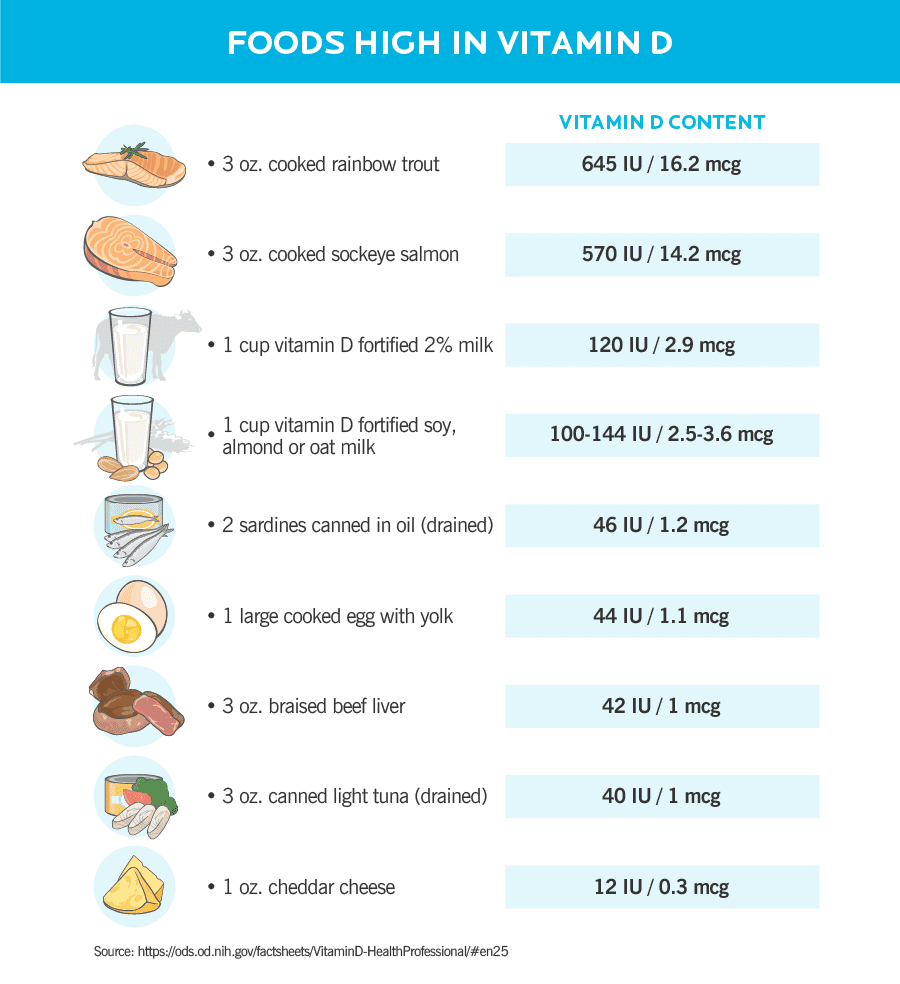
The perfect vitamin D complement
Vitamin D dietary supplements can come as a capsule, liquid, sublingual spray, or (sure) chewable gummy worm.
Whereas the supply technique of the complement isn’t so necessary4, the type of the vitamin D in it’s.
Normally, you’ll discover two types of vitamin D accessible in pharmacies and well being meals shops:
- Vitamin D2, derived from yeast or mushrooms (and vegan-friendly)
- Vitamin D3, usually sourced from lanolin (from sheep’s wool)
Whereas each varieties can elevate blood ranges of vitamin D, vitamin D3 seems to do a greater job of optimizing vitamin D ranges, in addition to sustaining these ranges longer-term.5,6,7
So, except you’re avoiding animal merchandise, search for a complement that comprises vitamin D3 (cholecalciferol).
Nevertheless—and that is necessary—taking vitamin D if you’re not poor may have little to no profit—and will even trigger hurt.8
(Extra on assess your danger of deficiency beneath.)
The interplay between vitamin D, calcium, and different vitamins
Meet vitamin D’s “colleagues.”
The next vitamins assist vitamin D’s position within the physique, in addition to mutually profit from vitamin D’s presence.
- Calcium is absorbed higher within the presence of vitamin D. That’s one of many causes vitamin D is necessary for bone well being. However, taking an excessive amount of of each could cause calcium to construct up in locations the place it doesn’t belong: mushy tissues just like the kidneys and arteries.9
- Vitamin Okay helps direct calcium to the place it’s imagined to go (principally, the bones).10 Taking vitamin Okay with vitamin D might forestall calcium from depositing into the mushy tissues.11,12,13
- Magnesium might assist convert vitamin D to its extra metabolically energetic varieties. Analysis reveals that taking magnesium with vitamin D is more practical at correcting a vitamin D deficiency than vitamin D supplementation alone.14,15
- Vitamin A can forestall vitamin D toxicity, and vice versa.3 Additionally, some research counsel that rising vitamin A can scale back the calcium buildup that may occur with increased ranges of vitamin D.16
There’s one caveat right here: Taking excessive doses of vitamin D together with excessive doses of any of those nutritional vitamins and minerals can, in some instances, backfire and contribute to well being issues. (Particularly in case you have different nutrient deficiencies.)
Whereas it’s most unlikely to “overdose” on vitamin from meals, dietary supplements can will let you mega-dose, and that’s the place potential points may come up.
When you’re uncertain about stability your dietary supplements, speak to your medical physician.
Vitamin D deficiency
Most specialists agree that having a blood stage of:
- 30-50 nmol/L (12-20 ng/mL) of 25-hydroxyvitamin D3, or 25(OH)D is inadequate for optimum well being
- <30 nmol/L (12 ng/mL) of 25(OH)D is taken into account a extreme deficiency
Ranges in each of those ranges possible profit from supplementation.17,18,19
How frequent is vitamin D deficiency?
Statistics counsel that between 20 and 40 p.c of adults and kids worldwide have inadequate ranges of vitamin D.19,20,21
Now right here’s a enjoyable quiz (properly, enjoyable for well being nerds like us):
When you reply “sure” to any of the next questions, you’re at an elevated danger of vitamin deficiency.
Do you:
- Dwell removed from the equator, and/or expertise winter? It’s almost unattainable to get sufficient vitamin D from daylight throughout sure seasons—often the colder months—even when you spend a number of time exterior.22
- Have darker pores and skin? Melanin—the pigment that makes pores and skin darkish—reduces the pores and skin’s capability to provide vitamin D when it’s been uncovered to daylight.17 Within the US, 89 p.c of Blacks and 69 p.c of Hispanics are poor in vitamin D.23
- Fall into the “50+” age class? Age decreases the physique’s capability to synthesize vitamin D on the pores and skin.24
- Have a continual sickness, malabsorption points, or have a BMI that categorizes you as “overweight”? Folks with sure sicknesses, malabsorption, or weight problems don’t essentially have hassle making vitamin D on the pores and skin, however they’re extra prone to have points absorbing and metabolizing it.25,26
- Are likely to cowl up if you go exterior (both with clothes or sunscreen)? Carrying clothes that covers most of your physique—for spiritual, type, or well being causes—or carrying sunscreen, protects your pores and skin from UVB and UVA mild, blocking vitamin D synthesis. Burn or pores and skin most cancers survivors could also be particularly vulnerable to slathering up with SPF.
- Simply not go exterior a lot (throughout daylight)? Whether or not because of sickness or shift work, when you’re not in a position to go exterior when the solar is highest, you’ll miss the window for optimum vitamin D synthesis.
Ailments related to vitamin D deficiency
As you may think, the more severe a deficiency is, the extra possible detrimental well being results begin to present up.
Extra excessive deficiencies of vitamin D dramatically improve the chance of untimely dying, infections, and lots of different ailments.27
Some ailments related to vitamin D deficiency:
- Osteoporosis, and basic weakening or softening of the bones26
- Immune dysfunction, equivalent to autoimmune situations and elevated susceptibility to an infection28
- Kind 2 diabetes29,30
- Heart problems31,32
- Most cancers, particularly most cancers mortality33,34,35
- Weight problems36
- Despair37
Drawback is, we don’t have clear proof that enhancing vitamin D standing alone reverses or improves these situations. Nor do we all know for certain if vitamin D deficiency or insufficiency is definitely what causes them within the first place.
Though vitamin D deficiency is said to those situations, we’re nonetheless making an attempt to determine how.
Vitamin D and Immunity
For years, vitamin D has been touted as an immune booster.
Because of this, it’s grow to be a preferred “simply in case” complement throughout flu seasons, and much more so in the course of the COVID-19 pandemic.
However bear in mind how we mentioned that supplementing with vitamin D gained’t possible profit you when you aren’t poor?
That applies to immune perform too.
Taking additional vitamin D when your ranges are regular gained’t offer you “tremendous immunity.”
It’s true that vitamin D deficiency is linked to extra frequent and extra extreme infections, like higher respiratory tract sicknesses,38 and COVID-19.39,40
So sure, when you’re frightened about your immune well being and you watched you might have a vitamin D deficiency, get examined.
In case you have a confirmed deficiency, get these D ranges into a traditional vary: 50-100 nmol/L (20-40 ng/mL) of 25(OH)D.
(Your physician can assist you determine the correct dose of vitamin D, and the way lengthy to take it for.)
Then again, in case your vitamin D ranges are regular, there’s no motive to complement.
Study extra: 8 ways to optimize your immunity and protect your health.
Vitamin D: Your subsequent steps
1. If doable, get some (protected) solar publicity, and intention to eat vitamin D-rich meals.
Many individuals’s vitamin D necessities can and must be met via solar publicity and weight-reduction plan alone.
Eat vitamin D-rich meals, together with a spread of colorful fruits and veggies excessive in nutritional vitamins and minerals—like calcium, magnesium, vitamin Okay, and vitamin A—that assist vitamin D’s work within the physique.
As a coach, except you might have one other designation that qualifies you to apply Medical Diet Remedy (MNT), you’re finest to stay with meals and life-style practices to assist your shoppers meet their vitamin D necessities.
Coaches can educate shoppers about their danger components, or present basic tips for vitamin D consumption, however solely certified MNT practitioners can diagnose and deal with deficiencies.
2. When you suspect a deficiency, get a blood take a look at.
When doable, get a blood take a look at to verify suspected deficiencies. (That goes for different vitamins too—like iron or vitamin B12—not simply vitamin D.)
And, do not forget that within the presence of different deficiencies, we must be cautious about supplementing with excessive doses of vitamin D.
Seek the advice of a physician that can assist you decide if there’s a deficiency, and in that case, what dose to take to treatment it.
3. Be aware of those that are extra susceptible to deficiency.
In case you have a consumer who:
- has malabsorption points
- has darker pores and skin
- lives removed from the equator
- covers up (both with garments or sunscreen)
…know that vitamin D deficiency is frequent.20
And most of the people low in vitamin D gained’t “really feel” it.
Whereas some may get colds or flus a bit extra usually,41 many individuals don’t have any signs in any respect.
If a consumer falls into a number of of the “in danger” classes (particularly if their weight-reduction plan can be low in vitamin D meals sources), it’s not a foul concept to counsel that they work with a physician, and get examined.
The underside line: Even when one thing is crucial to our well being—like nutritional vitamins, minerals, water, and, oh, let’s say, a great stash of bathroom paper—extra isn’t all the time higher.
jQuery(doc).prepared(perform(){
jQuery(“#references_link”).click on(perform(){
jQuery(“#references_holder”).present();
jQuery(“#references_link”).guardian().disguise();
});
});
References
Click on right here to view the knowledge sources referenced on this article.
1. Schottker B, Haug U, Schomburg L, et al. Strong associations of 25-hydroxyvitamin D concentrations with all-cause, cardiovascular, cancer, and respiratory disease mortality in a large cohort study. Am J Clin Nutr. 2013 Apr;97(4):782-93.
2. Kimball, Samantha M., and Michael F. Holick. 2020. “Official Recommendations for Vitamin D through the Life Stages in Developed Countries.” European Journal of Scientific Diet 74 (11): 1514–18.
3. “Vitamin D.” n.d. Accessed March 29, 2021. https://ods.od.nih.gov/factsheets/VitaminD-HealthProfessional/.
4. Grammatikopoulou, Maria G., Konstantinos Gkiouras, Meletios P. Nigdelis, Dimitrios P. Bogdanos, and Dimitrios G. Goulis. 2020. “Efficacy of Vitamin D3 Buccal Spray Supplementation Compared to Other Delivery Methods: A Systematic Review of Superiority Randomized Controlled Trials.” Vitamins 12 (3). https://doi.org/10.3390/nu12030691.
5. Tripkovic, Laura, Helen Lambert, Kathryn Hart, Colin P. Smith, Giselda Bucca, Simon Penson, Gemma Chope, et al. 2012. “Comparison of Vitamin D2 and Vitamin D3 Supplementation in Raising Serum 25-Hydroxyvitamin D Status: A Systematic Review and Meta-Analysis.” The American Journal of Scientific Diet 95 (6): 1357–64.
6. Logan, Victoria F., Andrew R. Grey, Meredith C. Peddie, Michelle J. Harper, and Lisa A. Houghton. 2013. “Long-Term Vitamin D3 Supplementation Is More Effective than Vitamin D2 in Maintaining Serum 25-Hydroxyvitamin D Status over the Winter Months.” The British Journal of Diet 109 (6): 1082–88.
7. Vieth, Reinhold. 2020. “Vitamin D Supplementation: Cholecalciferol, Calcifediol, and Calcitriol.” European Journal of Scientific Diet 74 (11): 1493–97.6
8. Khan, Safi U., Muhammad U. Khan, Haris Riaz, Shahul Valavoor, Di Zhao, Lauren Vaughan, Victor Okunrintemi, et al. 2019. “Effects of Nutritional Supplements and Dietary Interventions on Cardiovascular Outcomes: An Umbrella Review and Evidence Map.” Annals of Inside Drugs 171 (3): 190–98.
9. Michos, Erin D., Miguel Cainzos-Achirica, Amir S. Heravi, and Lawrence J. Appel. 2021. “Vitamin D, Calcium Supplements, and Implications for Cardiovascular Health: JACC Focus Seminar.” Journal of the American School of Cardiology 77 (4): 437–49.
10. Ushiroyama, Takahisa, Atushi Ikeda, and Minoru Ueki. 2002. “Effect of Continuous Combined Therapy with Vitamin K(2) and Vitamin D(3) on Bone Mineral Density and Coagulofibrinolysis Function in Postmenopausal Women.” Maturitas 41 (3): 211–21.
11. Shea, M. Kyla, and Rachel M. Holden. 2012. “Vitamin K Status and Vascular Calcification: Evidence from Observational and Clinical Studies.” Advances in Diet 3 (2): 158–65.
12. Shea, M. Kyla, Christopher J. O’Donnell, Udo Hoffmann, Gerard E. Dallal, Bess Dawson-Hughes, José M. Ordovas, Paul A. Value, Matthew Okay. Williamson, and Sarah L. Sales space. 2009. “Vitamin K Supplementation and Progression of Coronary Artery Calcium in Older Men and Women.” The American Journal of Scientific Diet 89 (6): 1799–1807.
13. Masterjohn, Christopher. 2007. “Vitamin D Toxicity Redefined: Vitamin K and the Molecular Mechanism.” Medical Hypotheses 68 (5): 1026–34.
14. Deng, Xinqing, Yiqing Tune, Joann E. Manson, Lisa B. Signorello, Shumin M. Zhang, Martha J. Shrubsole, Reid M. Ness, Douglas L. Seidner, and Qi Dai. 2013. “Magnesium, Vitamin D Status and Mortality: Results from US National Health and Nutrition Examination Survey (NHANES) 2001 to 2006 and NHANES III.” BMC Drugs 11 (August): 187.
15. Uwitonze, Anne Marie, and Mohammed S. Razzaque. 2018. “Role of Magnesium in Vitamin D Activation and Function.” The Journal of the American Osteopathic Affiliation 118 (3): 181–89.
16. Johansson, S., and H. Melhus. 2001. “Vitamin A Antagonizes Calcium Response to Vitamin D in Man.” Journal of Bone and Mineral Analysis: The Official Journal of the American Society for Bone and Mineral Analysis 16 (10): 1899–1905.
17. Institute of Drugs (US) Committee to Assessment Dietary Reference Intakes for Vitamin D and Calcium. 2011. Dietary Reference Intakes for Calcium and Vitamin D. Edited by A. Catharine Ross, Christine L. Taylor, Ann L. Yaktine, and Heather B. Del Valle. Washington (DC): Nationwide Academies Press (US).
18. Holick, Michael F., Neil C. Binkley, Heike A. Bischoff-Ferrari, Catherine M. Gordon, David A. Hanley, Robert P. Heaney, M. Hassan Murad, Connie M. Weaver, and Endocrine Society. 2011. “Evaluation, Treatment, and Prevention of Vitamin D Deficiency: An Endocrine Society Clinical Practice Guideline.” The Journal of Scientific Endocrinology and Metabolism 96 (7): 1911–30.
19. Amrein, Karin, Mario Scherkl, Magdalena Hoffmann, Stefan Neuwersch-Sommeregger, Markus Köstenberger, Adelina Tmava Berisha, Gennaro Martucci, Stefan Pilz, and Oliver Malle. 2020. “Vitamin D Deficiency 2.0: An Update on the Current Status Worldwide.” European Journal of Scientific Diet 74 (11): 1498–1513.
20. Parva, Naveen R., Satish Tadepalli, Pratiksha Singh, Andrew Qian, Rajat Joshi, Hyndavi Kandala, Vinod Okay. Nookala, and Pramil Cheriyath. 2018. “Prevalence of Vitamin D Deficiency and Associated Risk Factors in the US Population (2011-2012).” Cureus 10 (6): e2741.
21. Cashman, Kevin D., Tony Sheehy, and Colette M. O’Neill. 2019. “Is Vitamin D Deficiency a Public Health Concern for Low Middle Income Countries? A Systematic Literature Review.” European Journal of Diet 58 (1): 433–53.
22. Wacker, Matthias, and Michael F. Holick. 2013. “Sunlight and Vitamin D: A Global Perspective for Health.” Dermato-Endocrinology 5 (1): 51–108.
23. Forrest, KY, Stuhldreher, WL. Prevalence and correlates of vitamin D deficiency in US adults. Nutr Res. 2011 Jan;31(1):48-54.
24. Chalcraft, Jenna R., Linda M. Cardinal, Perry J. Wechsler, Bruce W. Hollis, Kenneth G. Gerow, Brenda M. Alexander, Jill F. Keith, and D. Enette Larson-Meyer. 2020. “Vitamin D Synthesis Following a Single Bout of Sun Exposure in Older and Younger Men and Women.” Vitamins 12 (8). https://doi.org/10.3390/nu12082237.
25. Silva, Mariana Costa, and Tania Weber Furlanetto. 2018. “Intestinal Absorption of Vitamin D: A Systematic Review.” Diet Evaluations 76 (1): 60–76.
26. Institute of Drugs, Meals and Diet Board, and Committee to Assessment Dietary Reference Intakes for Vitamin D and Calcium. 2011. Dietary Reference Intakes for Calcium and Vitamin D. Nationwide Academies Press.
27. Wang, Hanmin, Weiwen Chen, Dongqing Li, Xiaoe Yin, Xiaode Zhang, Nancy Olsen, and Tune Guo Zheng. 2017. “Vitamin D and Chronic Diseases.” Getting old and Illness 8 (3): 346–53.
28. Aranow, Cynthia. 2011. “Vitamin D and the Immune System.” Journal of Investigative Drugs: The Official Publication of the American Federation for Scientific Analysis 59 (6): 881–86.
29. Li, Xinyi, Yan Liu, Yingdong Zheng, Peiyu Wang, and Yumei Zhang. 2018. “The Effect of Vitamin D Supplementation on Glycemic Control in Type 2 Diabetes Patients: A Systematic Review and Meta-Analysis.” Vitamins 10 (3). https://doi.org/10.3390/nu10030375.
30. Pittas, Anastassios G., Bess Dawson-Hughes, Patricia Sheehan, James H. Ware, William C. Knowler, Vanita R. Aroda, Irwin Brodsky, et al. 2019. “Vitamin D Supplementation and Prevention of Type 2 Diabetes.” The New England Journal of Drugs 381 (6): 520–30.
31. Kassi, Eva, Christos Adamopoulos, Efthimia Okay. Basdra, and Athanasios G. Papavassiliou. 2013. “Role of Vitamin D in Atherosclerosis.” Circulation 128 (23): 2517–31.
32. Al Mheid, Ibhar, and Arshed A. Quyyumi. 2017. “Vitamin D and Cardiovascular Disease: Controversy Unresolved.” Journal of the American School of Cardiology 70 (1): 89–100.
33. Yin, Lu, José M. Ordóñez-Mena, Tianhui Chen, Ben Schöttker, Volker Arndt, and Hermann Brenner. 2013. “Circulating 25-Hydroxyvitamin D Serum Concentration and Total Cancer Incidence and Mortality: A Systematic Review and Meta-Analysis.” Preventive Drugs 57 (6): 753–64.
34. Han, Jianmin, Xiaofei Guo, Xiao Yu, Shuang Liu, Xinyue Cui, Bo Zhang, and Hui Liang. 2019. “25-Hydroxyvitamin D and Total Cancer Incidence and Mortality: A Meta-Analysis of Prospective Cohort Studies.” Vitamins 11 (10). https://doi.org/10.3390/nu11102295.
35. Keum, N., and E. Giovannucci. 2014. “Vitamin D Supplements and Cancer Incidence and Mortality: A Meta-Analysis.” British Journal of Most cancers 111 (5): 976–80.
36. Earthman, C. P., L. M. Beckman, Okay. Masodkar, and S. D. Sibley. 2012. “The Link between Obesity and Low Circulating 25-Hydroxyvitamin D Concentrations: Considerations and Implications.” Worldwide Journal of Weight problems 36 (3): 387–96.
37. Anglin, Rebecca E. S., Zainab Samaan, Stephen D. Walter, and Sarah D. McDonald. 2013. “Vitamin D Deficiency and Depression in Adults: Systematic Review and Meta-Analysis.” The British Journal of Psychiatry: The Journal of Psychological Science 202 (February): 100–107.
38. Hughes, D. A., and R. Norton. 2009. “Vitamin D and Respiratory Health.” Scientific and Experimental Immunology 158 (1): 20–25.
39. Baktash, Vadir, Tom Hosack, Nishil Patel, Shital Shah, Pirabakaran Kandiah, Koenraad Van den Abbeele, Amit Okay. J. Mandal, and Constantinos G. Missouris. 2020. “Vitamin D Status and Outcomes for Hospitalised Older Patients with COVID-19.” Postgraduate Medical Journal, August. https://doi.org/10.1136/postgradmedj-2020-138712.
40. Carpagnano, G. E., V. Di Lecce, V. N. Quaranta, A. Zito, E. Buonamico, E. Capozza, A. Palumbo, G. Di Gioia, V. N. Valerio, and O. Resta. 2021. “Vitamin D Deficiency as a Predictor of Poor Prognosis in Patients with Acute Respiratory Failure due to COVID-19.” Journal of Endocrinological Investigation 44 (4): 765–71.
41. Schwalfenberg, Gerry Okay. 2011. “A Review of the Critical Role of Vitamin D in the Functioning of the Immune System and the Clinical Implications of Vitamin D Deficiency.” Molecular Diet & Meals Analysis 55 (1): 96–108.
When you’re a coach, otherwise you need to be…
Studying coach shoppers, sufferers, buddies, or relations via wholesome consuming and life-style adjustments—in a method that’s personalised for his or her distinctive physique, preferences, and circumstances—is each an artwork and a science.
When you’d wish to be taught extra about each, contemplate the Precision Nutrition Level 1 Certification. The subsequent group kicks off shortly.
<!—Snippet to cover
When you’re a coach, otherwise you need to be…
Studying coach shoppers, sufferers, buddies, or relations via wholesome consuming and life-style adjustments—in a method that’s personalised for his or her distinctive physique, preferences, and circumstances—is each an artwork and a science.
When you’d wish to be taught extra about each, contemplate the Precision Nutrition Level 1 Certification.
–>
The put up “Should I take vitamin D?” Here’s what the science says. appeared first on Precision Nutrition.
