


Saturated fats can create fairly the dietary dilemma.
For many of your life, you’ve most likely been instructed it’s unhealthy. That saturated fats clogs your arteries and results in coronary heart assaults.
Then again, sort in the best Google search phrases, and also you’ll discover research-based articles that say that considering is outdated and flawed.
A frequent declare: The concept that saturated fats is “dangerous” was primarily based on dangerous science, and that, in actuality, it’s completely wholesome. So wholesome, in reality, you don’t want to limit it. (Some say you need to even eat extra of it.)
There’s additionally this: Meals that comprise saturated fats typically style scrumptious.
You get the image.
It’s sufficient to go away you standing in your grocery retailer’s butter part, frozen in indecision. Ultimately, possibly you seize a stick however secretly marvel should you’re holding a grenade.
Like many different issues we eat (carbs! purple meat! soy!) saturated fats is… controversial.
However with the intention to make knowledgeable meals decisions for your self and your loved ones—or should you’re a coach, assist your shoppers do the identical—you need some readability.
Right here’s the reality about saturated fats.
++++
Why do we predict saturated fats is dangerous?
In 1978, the Seven Nations Research was revealed. This research, led by American physiologist Ancel Keys, famous:
- a greater incidence of coronary heart illness in international locations the place the consumption of saturated fat was excessive (just like the US)
- a decrease incidence of coronary heart illness in international locations the place the consumption of saturated fat was low (like Italy, Greece, and Spain)
From this remark, Keys hypothesized that saturated fat trigger heart problems (CVD), and must be averted. He additionally proposed that unsaturated fat from crops had been protecting, and must be emphasised.
(Cool truth: These observations led to the idea of the Mediterranean eating regimen.)
It’s largely because of the Seven Nations research and Ancel Keys that we have now this affiliation between saturated fat and coronary heart illness.
However is it true?
Effectively, sure, but it surely’s sophisticated. In case you’ve been following us for some time, you could have seen that diet science is seldom black or white.
For instance, it’s uncommon that we will say one complete class of meals is “dangerous” for everybody—or, for that matter, “good” for everybody. (Be taught extra: Why we’ve told over 100,000 clients: There are no “bad” foods.)
The identical is true of saturated fats. Whereas for some folks it might improve ldl cholesterol and threat of heart problems, for others, it doesn’t.
And, as with many different issues, “it’s the dose that makes the poison.”
Extra saturated fats isn’t good for anybody. (However that recommendation applies even to much less controversial issues, like water, so we’re not saying something attention-grabbing there.)
It’s been about half a century since Keys made his observations. Since then, science has continued to chip away on the reality about saturated fats.
We’ll let you know the whole lot we all know, together with what saturated fats does within the physique, what meals it comes from, and the way a lot of it to eat.
Fat: A crash course
Earlier than we talk about the several types of fat, let’s zoom out and discuss fat usually. (In case you’re aren’t up for a biochemistry lesson, you possibly can skip proper to the next section if you need.)
All fat are composed of fatty acids and a compound referred to as glycerol. Fat we eat are inclined to have one glycerol “spine” with three fatty acids connected to it. These are often known as triglycerides.
That will help you visualize, when drawn, the chemical construction of a triglyceride seems to be quite a bit like a capital letter “E” (the arms of the “E” are fatty acids).
See?
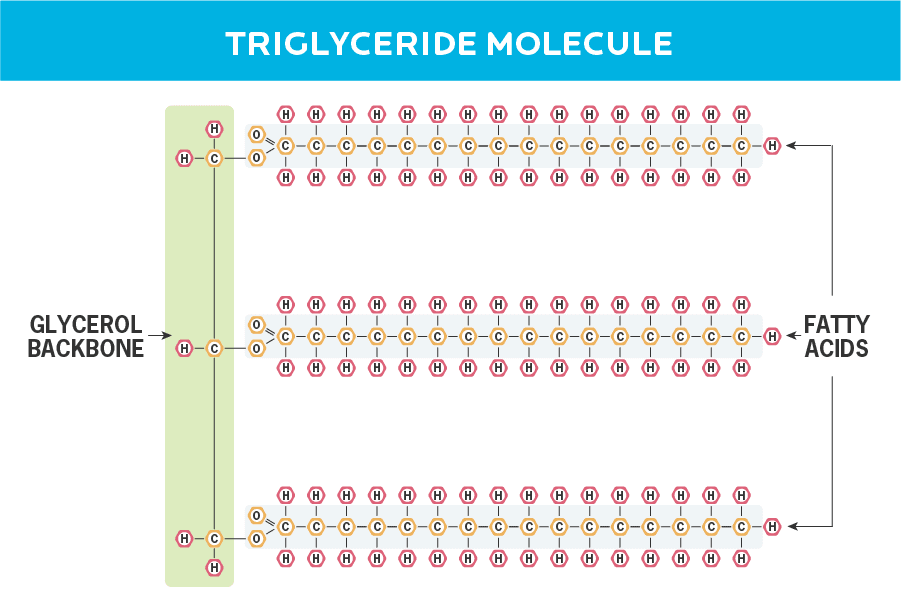
Every fatty acid consists of a “chain” of carbon atoms which are chemically bonded to one another.
This “chain” may be 2 to 24 carbon atoms in size. In different phrases, fatty acids can fluctuate in dimension.
What’s extra, every carbon atom has two open “spots” the place it will possibly bond with as much as two hydrogen atoms.
How these spots are crammed are what determines a fatty acid’s chemical construction. (Typically, hydrogen solely fills one of many two open spots.)
In case you needed to re-read that a few instances—and nonetheless don’t fairly get it—don’t fear. For one, that’s regular. That is summary stuff. (We’re speaking about atoms!) And secondly, it doesn’t actually matter.
Simply know this: The phrases “saturated,” “monounsaturated,” and “polyunsaturated” all describe fatty acids with barely completely different chemical buildings, because of the sorts of bonds they’ve.
These structural variations in chemical construction end in completely different capabilities and results within the physique.
What are saturated fat?
Saturated fatty acids (and fat) are referred to as “saturated” as a result of should you have a look at their chemical construction, every carbon atom types a single bond with two hydrogen gadgets.
The end result: Their carbon chain is “crammed” to capability (saturated!) with hydrogens. (You possibly can’t match any extra.)
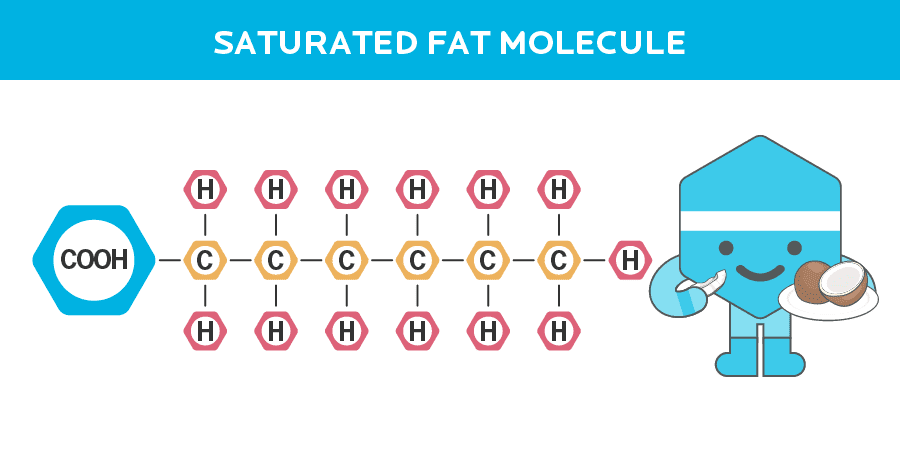
Saturated fats isn’t one single factor. It’s really a household of many several types of fatty acids.
Keep in mind how we stated fatty acids have completely different chain lengths? You possibly can have 4-carbon saturated fatty acids, 6-carbon saturated fatty acids, 8-carbon… you get the purpose.
Listed here are a couple of examples of kinds of saturated fatty acids (SFA):
- Butyric acid (a 4-carbon SFA produced by intestine micro organism through fiber fermentation)
- Caprylic acid (an 8-carbon SFA present in coconut)
- Palmitic acid (a 16-carbon SFA present in palm oil and animal fat)
- Stearic acid (an 18-carbon SFA present in purple meat and cocoa butter)
- Arachidic acid (a 20-carbon SFA present in peanuts)
(Observe: We’ve used the frequent names for these fatty acids. For the scientific names, seek the advice of the chart in this nerdy document, courtesy of the Meals and Agriculture Group of the United Nations.)
Saturated fat vs. unsaturated fat: What’s the distinction?
Unsaturated fat embrace monounsaturated fat and polyunsaturated fat.
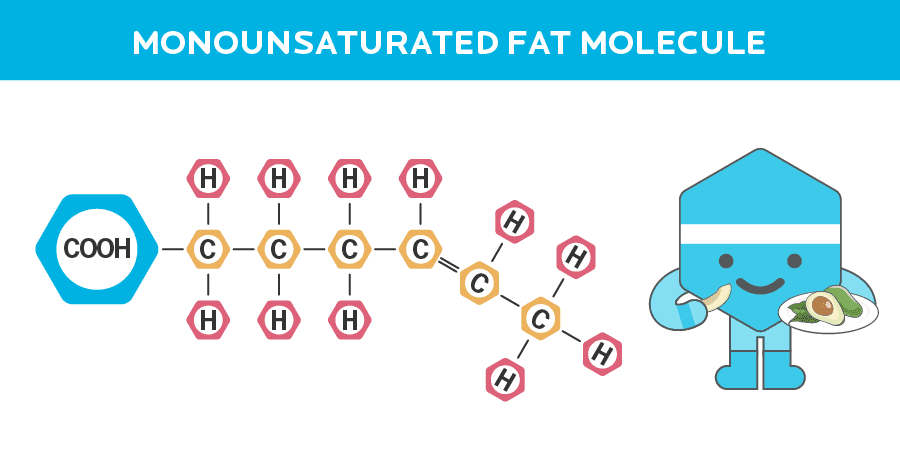
Monounsaturated fat have one double bond (thus the prefix “mono”) as a result of two spots aren’t taken up by hydrogen. (When two carbons have an open spot, they kind a double bond with one another.)
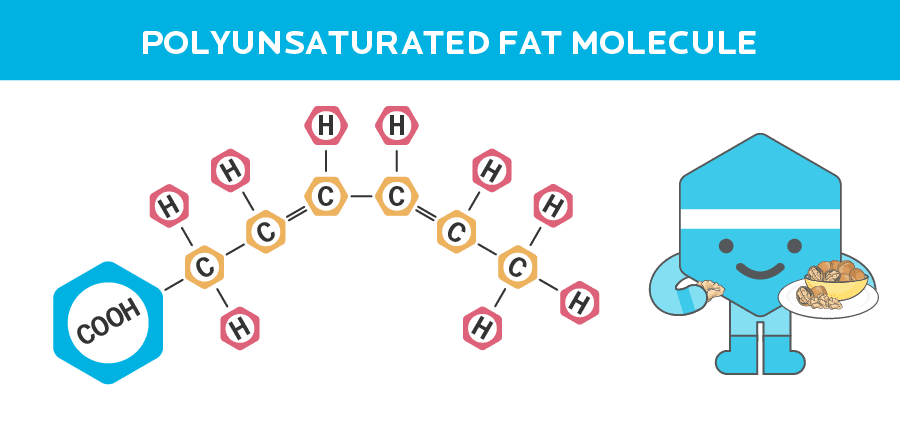
Polyunsaturated fatty acids have a number of double bonds (thus the prefix “poly”), as a result of they’ve a number of spots that aren’t taken up by hydrogens.
Right here’s a simple approach to inform if a fats is saturated or unsaturated:
If it’s stable or semisolid at room temperature (21℃), it’s most likely saturated. (There are a couple of exceptions.) Assume: butter, coconut oil, and cocoa butter.
If it’s liquid, it’s very seemingly unsaturated. For instance, sunflower oil, canola oil, and olive oil.
This is the reason: As a result of unsaturated fatty acids have a number of double bonds, there’s a “kink” or a bend of their bodily form. They will’t pack collectively as tightly, making them ”unfastened” and liquid at room temperature.
In the meantime, saturated fatty acids are straight, and might pack tightly collectively. That retains them stable at room temperature.
Most dietary fats sources are made up of some mixture of saturated, polyunsaturated, and monounsaturated fatty acids.
Trans fat: The true “dangerous” fats
The final sort of fats is trans fatty acids. And if there’s one sort of fats you need to keep away from, it’s this one.
Trans fatty acids are often the product of commercial meals processing, the place polyunsaturated fat are artificially “saturated” with further hydrogen.
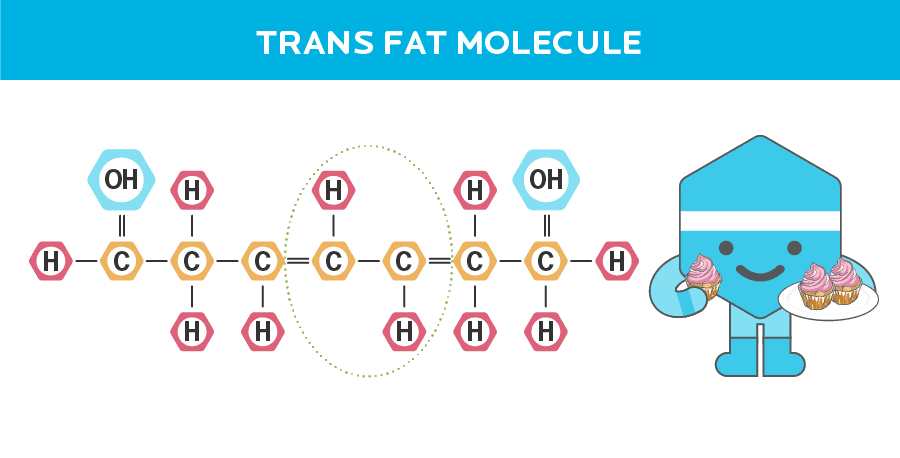
As we’ve seen, the chemical construction of saturated fatty acids makes them straight, whereas the chemical construction of unsaturated fatty acids offers them a minimum of one bend. This form impacts their operate within the physique.
When unsaturated fatty acids undergo chemical hydrogenation, the fatty acids take a trans configuration, which straightens the molecule in order that it seems to be (and acts) extra like a saturated fats.
Meals producers like utilizing trans fatty acids of their merchandise as a result of it extends the shelf lifetime of a meals.
Human our bodies although, don’t take care of trans fat so nicely.
In actual fact: Trans fatty acids are straight linked to an elevated threat of heart problems, breast most cancers, issues throughout being pregnant, colon most cancers, diabetes, weight problems, and allergy.1,2,3
The FDA has even decided that industrially hydrogenated fat are now not “Usually Acknowledged as Secure” (GRAS), and have taken steps to have them faraway from our meals provide.4
Nevertheless, trans fat are nonetheless round. Vegetable shortening, some margarines, some cooking oils, and the processed meals and baked items comprised of all of them have trans fat.
That’s why it’s nonetheless essential to learn ingredient labels: Any product that lists “partially hydrogenated oil” incorporates trans fat.
In case you’re interested by your well being, you need to reduce or keep away from these merchandise as a lot as doable. The World Well being Affiliation (WHO) recommends that individuals restrict their consumption of trans fat to 1 % or much less of day by day energy.5
Observe: There are additionally a couple of naturally occurring trans fat, referred to as ruminant trans fatty acids, like conjugated linoleic acid (CLA) and vaccenic acid (VA).
These trans fatty acids get their identify as a result of they’re created through micro organism within the stomachs of “ruminant” animals, resembling cows, sheep, and goats. In contrast to industrially produced trans fatty acids, ruminant trans fatty acids aren’t related to destructive well being results.6
Which meals are excessive in saturated fats?
As we talked about, most fat-rich meals are a mixture of fat: saturated, monounsaturated, and polyunsaturated.
And truly, even meals which are thought-about “fat” are a mixture of vitamins total. (For instance, avocado additionally incorporates carbs and protein along with fat, as do walnuts, and most different whole-food fats sources.)
Meals we name “fat” often have fats because the predominant macronutrient. Equally, meals we name “saturated fats sources” have saturated fats because the predominant fats sort.
Dietary sources of saturated fats
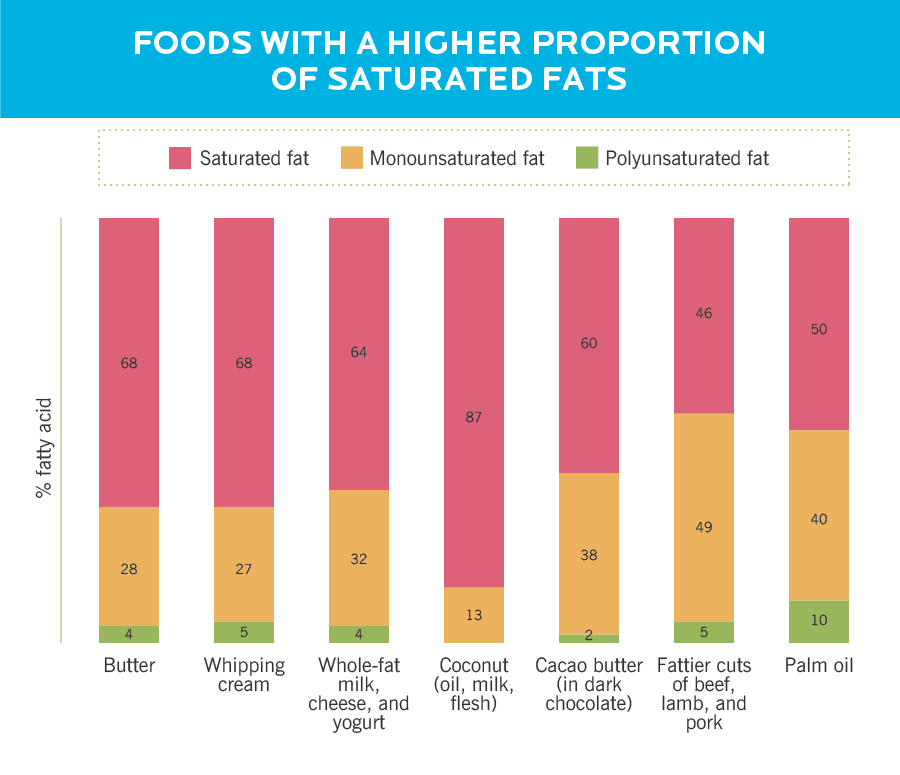
Meals with a better proportion of saturated fat embrace:
- Butter
- Whipping cream
- Complete fats milk, cheese, and yogurt
- Coconut (oil, milk, flesh)
- Cacao butter (darkish chocolate)
- Fattier cuts of beef, lamb, and pork
- Palm oil
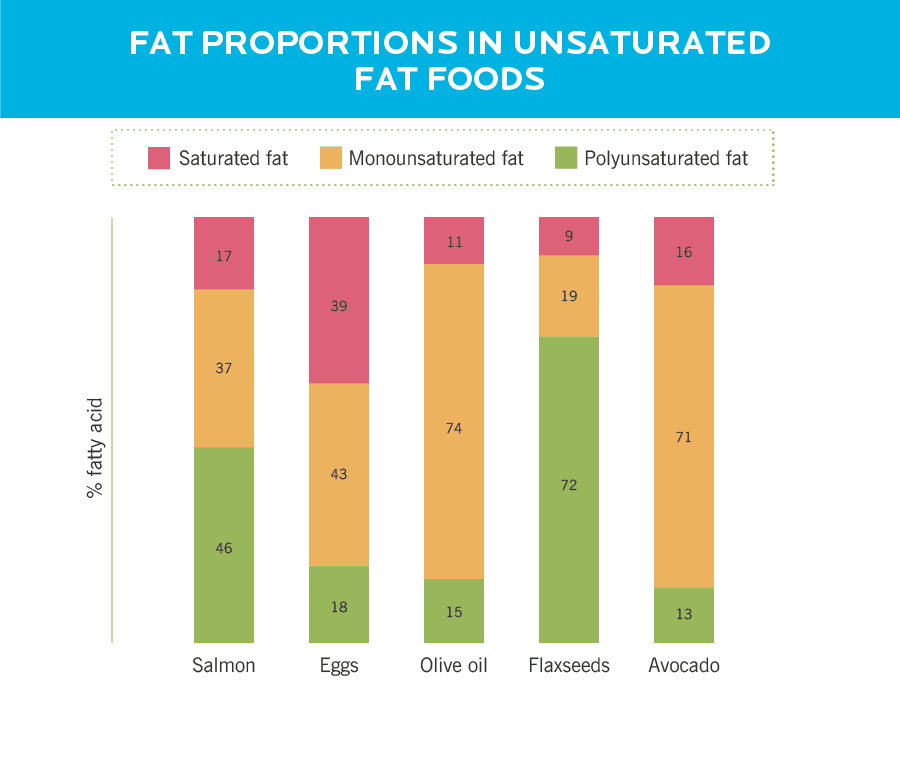
Meals with a better proportion of unsaturated fat (however nonetheless have some saturated fat) embrace:
- Salmon
- Eggs
- Olive oil
- Flaxseeds
- Avocado
- And others
Okay, however will butter kill me sooner or not?
Lastly, a solution to your burning query.
No. Saturated fat aren’t inherently dangerous.
A nutritious diet will naturally embrace some saturated fat, as a result of saturated fat are in lots of wholesome meals (resembling nuts and seeds, animal merchandise, coconut, and avocado).
However, like most meals, saturated fat are finest consumed moderately.
Right here’s why…
Saturated fat, ldl cholesterol, and heart problems
These Mediterraneans—those noticed by Ancel Keys—might have been on to one thing. With their diets primarily based round greens, complete grains, fruits, seafood, olives, nuts, and slightly little bit of dairy, they confirmed remarkably low charges of coronary heart illness.
In distinction, the Individuals in that research—with their diets wealthy in saturated fats, meat, dairy, and dessert, and decrease in greens—had a few of the highest charges of coronary heart illness on the earth.
With the assistance of science, we now perceive these observations slightly higher.
Right here’s what we all know:
▶ Saturated fat consumed in extra (over 10 % of day by day energy) improve LDL (the “dangerous”) ldl cholesterol, in addition to the probability of coronary heart assault, stroke, and cardiovascular occasions total.7,8
As saturated fats consumption goes down, so does the chance of cardiovascular occasions.8
Nevertheless, saturated fat don’t improve your threat of dying. In addition they seem to have little to no impact on most cancers threat, diabetes, HDL ldl cholesterol, triglycerides, or blood stress.8
▶ Trans fat, then again, improve each your threat of cardiovascular illnesses and loss of life.9
▶In the meantime, monounsaturated and polyunsaturated fats consumption is related to a decrease threat of heart problems and loss of life.10
What does this all imply?
Effectively, it signifies that relating to fat, we should always:
- Prioritize meals wealthy in mono- and polyunsaturated fat, like most nuts and seeds, seafood, olives and olive oil, and avocado.
- Average meals wealthy in saturated fat, like fattier cuts of meat, excessive fats dairy merchandise and the meals comprised of them, palm oil, and coconut.
- Scale back or remove meals wealthy in trans fat, like processed meals, vegetable shortening, and margarine / cooking oils made with hydrogenated oils.
So, ought to everybody simply reduce down on saturated fat?
Most individuals in Western international locations eat a reasonably excessive proportion of saturated fat. So many individuals ought to take into consideration lowering their saturated fats consumption.
(Additionally, so far as we all know, lowering saturated fat doesn’t appear to have any dangerous results.)8
However…
Reducing again on saturated fats isn’t all the time a superb factor, as a result of it depends upon what you’re including instead.
We all know that when saturated fat are eaten in extra, changing a few of these saturated fat with unsaturated fat can enhance well being.11
Nevertheless, when folks decrease their consumption of saturated fat, changing these energy with refined carbohydrates, the chance of coronary heart assault goes up.12
Additionally, not all saturated fatty acids within the saturated fats household have the identical impact. For instance, stearic acid, a saturated fatty acid present in beef and cocoa butter, appears to lower or haven’t any impact on LDL ldl cholesterol.13
The fact is that this: How saturated fats impacts the physique is influenced by a lot of different issues, like:
- Quantities and kinds of different fat within the eating regimen
- Fruit, vegetable, and fiber consumption
- Calorie extra
- Train frequency and depth
- Stress load and administration
- Genetics
And extra.
So, it’s sophisticated.
Based mostly on the physique of proof, evidently relating to protecting dietary fat in a wholesome vary, we need to contemplate two issues:
- Quantity: Not an excessive amount of and never too little. Roughly 30 % of your day by day energy ought to come from several types of fats (saturated, monounsaturated, and polyunsaturated).
- Ratio: Intention for roughly equal proportions of saturated, monounsaturated, and polyunsaturated fat.
Particular numbers apart, the take-home message is that this: In case you’re consuming a reasonably balanced complete meals eating regimen, and also you’re not consuming extra energy, you most likely don’t want to fret an excessive amount of about your saturated fats consumption.
However, you additionally most likely shouldn’t purposely improve your consumption of saturated fat for so-called “therapeutic” results (instance: the butter coffee trend).
That places saturated fat squarely within the “get pleasure from moderately” class.
How a lot saturated fats ought to I eat?
As all the time, the reply is: It relies upon.
However a superb basic guideline is that saturated fat ought to make up about 10 % or much less of whole day by day energy.14
Which means a pattern 2,000 Calorie eating regimen can have about 200 Energy—or about 22.2 grams—coming from saturated fat. (Modify up or down in response to your particular power necessities.)
Listed here are a pair examples of what this may appear to be:
- 7 oz sirloin steak = 12 grams saturated fats
- 1 oz chunk of cheddar cheese = 6 grams saturated fats
- 3 giant eggs = 5 grams saturated fats
= 23 grams saturated fats
Or:
- 6 oz salmon = 5 grams saturated fats
- 1 tablespoon of coconut oil = 12 grams saturated fats
- 1 avocado = 4 grams saturated fats
= 21 grams of saturated fats
As you possibly can see, it’s simple to fulfill this 10 %.
It’s additionally simple to go over 10 %, particularly if fattier cuts of meat and cooking fat like butter, coconut oil, or palm oil are regulars in your eating regimen.
Nevertheless, if together with these sources of saturated fats, you’re additionally getting…
- A very good steadiness of unsaturated fat (from further virgin olive oil, nuts, and seeds)
- Sufficient protein, carbohydrates, and colourful vegatables and fruits from quite a lot of minimally-processed complete meals (Be taught extra: “What foods should I eat?”)
- Day by day motion from stretching, strolling, resistance coaching, dancing, old style butter-churning
… you most likely don’t need to be troubled about saturated fat.
If you wish to discover out precisely how a lot fats—and carbohydrate, protein, and greens—your (or your shopper’s) physique wants to your most well-liked consuming model, take a look at our superior Nutrition Calculator.
Our big-picture recommendation to your on a regular basis life: Don’t get too caught up in (or overwhelmed by) the numbers.
As a substitute, deal with the next 4 factors.
1. Get a mixture of fat.
People developed consuming a various and seasonal eating regimen. We thrive finest on a mixture of fats sorts—in comparatively equal steadiness—from several types of meals.
This steadiness comes naturally if we select a wide array of various, complete, minimally-processed meals that comprise fats, resembling:
- nuts and seeds
- avocados
- dairy
- eggs
- fatty fish
- beef, pork, and lamb
- poultry
- wild sport
- olives and extra-virgin olive oil
Embrace one or two of the above fats sources at each meal, and also you’ll most likely meet your fats wants.
2. Keep away from trans fat.
Attempt to reduce or remove refined and processed meals containing industrially produced fat and artificially hydrogenated fat (learn: trans fat).
This occurs naturally the extra you middle your eating regimen round complete meals. (Find out how: The 5 principles of good nutrition.)
3. Contemplate the entire individual.
Most significantly, match your saturated fats consumption to your (or your shoppers’) distinctive physique, preferences, and wishes.
Individuals who have ldl cholesterol or cardiovascular points of their household could also be (genetically) extra delicate to the destructive results of saturated fat, and due to this fact ought to restrict their consumption.
Nevertheless, typically consuming barely greater quantities of saturated fats is acceptable. For instance:
- Bigger, extra muscular, and extra energetic folks can eat proportionately extra usually, together with extra saturated fat. Although, it’s nonetheless a good suggestion to maintain saturated fat within the vary of 10 % of whole day by day energy.
- If it’s significant for you or your shopper to have croissants, darkish chocolate, and occasional with cream, don’t “ban” it. Average it, perceive the tradeoffs, and savor the heck out of it.
- Some folks really feel good on a better fats eating regimen. For these of us, consuming extra fat (together with saturated fat) could be applicable. Nevertheless, if saturated fat are a foremost calorie supply, contemplate working along with your physician to check levels of cholesterol and blood lipids periodically to make sure they’re in a traditional vary.
4. When unsure (however nonetheless curious): Experiment.
Above, we instructed limiting saturated fats consumption to about 10 % of whole day by day energy.
Now, for most individuals, that’s a superb, conservative suggestion, particularly if in case you have a household historical past of excessive ldl cholesterol or heart problems.
However what if you wish to attempt a better fats eating regimen—say, the keto diet—and improve your consumption of fat total?
Effectively, simply attempt it.
To do that in a manner that helps you realize whether or not this sort of eating regimen works for you or not, simply undertake this mindset: Assume like a scientist.
Resolve what end result you’re searching for whereas attempting a better fats eating regimen: Decreased cravings? Fats loss? Higher power? (Learn extra: 3 diet experiments that can change your eating habits—and transform your body.)
Then, take some baseline measurements:
- Weight, girth measurements, pictures
- Power degree, sleep high quality, digestion, temper (you possibly can merely gauge these on a scale from 1 to 10)
- Ldl cholesterol (LDL, HDL, and whole), triglycerides, fasting blood sugar (work along with your medical physician to get and interpret these measurements)
- The rest you need to monitor, like cravings or meal satisfaction.
Subsequent, start your experiment: Improve your fats consumption.
“Verify in” each week or two to evaluate (most of) the above measurements. (In case you’re working with a medical physician to verify ldl cholesterol and different blood markers, repeat a blood take a look at after about three months.)
If issues appear to be going nicely for you, maintain going. Each few months, consider the way you’re doing total.
Feeling and searching higher? Avocado and coconut shakes nonetheless delish? Blood checks get a thumbs up from doc? Cool! Hold going and re-assess in one other six months or so. (For a fast and straightforward approach to decide how your eating regimen is working for you, attempt our Best Diet Quiz.)
Feeling crappy and blood lipids creeping up? Okay then. Reduce the fats—saturated fats particularly.
Tinker with issues till you (and your doc) are joyful.
Ignore the advertising and marketing claims for butter espresso—in addition to those for celery juice—and see what your personal physique says.
Most probably, that stick of butter isn’t a grenade. Neither is it a golden elixir of well being.
It’s simply butter.
References
Click on right here to view the data sources referenced on this article.
In case you’re a coach, otherwise you need to be…
Studying the way to coach shoppers, sufferers, associates, or relations by way of wholesome consuming and life-style adjustments—in a manner that’s personalised for his or her distinctive physique, preferences, and circumstances—is each an artwork and a science.
In case you’d prefer to be taught extra about each, contemplate the Precision Nutrition Level 1 Certification. The following group kicks off shortly.
