


Reviewed by: Pam Ruhland, PN2, Licensed Intuitive Consuming Lay Facilitator
What is it? | Principles | Weight loss | Mindful eating | Advice for coaches
Many individuals suppose they know what “intuitive consuming” means.
And loads of them are fallacious.
They’ll say issues like:
“Intuitive consuming is consuming no matter you need, everytime you need.”
“When you’re not on a weight loss program, you’re already consuming intuitively.”
Or everybody’s private favourite: “It simply means ‘hearken to your physique.’”
However none of these are correct, a minimum of not in line with the individuals who coined the time period.
And that issues.
Whether or not you’re taken with working towards intuitive consuming your self, otherwise you’re a coach contemplating utilizing it together with your shoppers, you’ll wish to know what intuitive consuming is and isn’t—so you’ll be able to determine whether or not it’s the best device for the job.
On this article, you’ll uncover:
- The ten ideas of intuitive consuming.
- Why intuitive consuming is perhaps proper—or fallacious—for you (or your shoppers).
- A lot of useful methods to attempt intuitive consuming—beginning right now.
Prepared? Let’s dig in.
++++
Over 150,000 health & fitness professionals certified
Save up to 30% on the industry’s top nutrition education program
Get a deeper understanding of nutrition, the authority to coach it, and the ability to turn that knowledge into a thriving coaching practice.
What’s intuitive consuming?
First popularized by Evelyn Tribole and Elyse Resch of their 1995 ebook Intuitive Eating: A Revolutionary Anti-Diet Approach, intuitive consuming rejects weight loss program tradition, a set of beliefs that values thinness, look, and form above well being and well-being.
This framework enthusiastically welcomes folks of all sizes, serving to them to enhance their relationships with meals, thoughts, and physique with out encouraging them to lose an oz.
Intuitive consuming additionally forgoes typical consuming guidelines (suppose weighing, measuring) and as a substitute helps folks rediscover physique cues like starvation and fullness.
That sounds nice, after all. However can it actually work?
For many individuals, intuitive consuming may be powerfully transformative.
By the point we hit our 20s, most of us are consuming for plenty of causes moreover precise starvation.
6 pm? Time for supper.
Bored? Let’s see what’s within the fridge.
Tough day? Give me a spoon and a few cookies n’ cream.
However think about how life may work out if we ate like infants.
Infants naturally eat intuitively, stopping once they’re full, irrespective of how a lot milk or formulation is left.
They don’t go to battle with themselves considering, “I would like extra. However, no, I shouldn’t. However, my gosh, it tastes so good. Just a little extra gained’t be so dangerous, proper? What’s fallacious with me? Why can’t I cease?! Okay, I do know. I’ll do 250 crawling laps across the room to burn off the additional milk…”
Intuitive consuming helps folks get nearer to this pure intuition once more.
The ten intuitive consuming ideas
If you wish to perceive what intuitive consuming has to supply, the ten ideas are an important place to begin. A method to make use of these ideas: Work by them so as. Grasp one, after which transfer on to the subsequent, which is what the creators initially supposed.
Precept #1: Reject the weight loss program mentality.
Intuitive consuming isn’t about weight reduction, and that’s exactly what attracted Lisa Dahl, PN2, a Licensed Intuitive Consuming Lay Facilitator.
She’d seen that a lot of her shoppers felt harassed and upset once they stepped on the size or tracked their measurements. So when she found intuitive consuming, she shifted her complete teaching follow away from weight reduction.
That shift had a significant impression on Dahl’s shoppers and her teaching: “Once we eliminated the weight loss program mentality, we shifted our focus to behaviors and actions that had been making them really feel higher—whatever the quantity on the size. It grew to become a way more optimistic expertise for each of us.”
When you’re taken with making an attempt this method, take into consideration your targets exterior of weight reduction through the use of a thought experiment referred to as The 5 Whys.
You begin with the query: What do you wish to accomplish? After which ask your self why 5 occasions to get to the foundation of what you actually need.
Usually, folks begin by saying they wish to drop some weight. By the tip, they find yourself with targets about confidence, happiness, and having an excellent life—all of which may be achieved with out weight reduction.
To study extra about learn how to use The 5 Whys to reject the weight loss program mentality, see: Are you body-shaming clients? How well-meaning coaches can be guilty of “size-bias.”
However what about individuals who “want” to drop some weight?
It is a loaded query. However there are a couple of vital factors to think about.
➤ #1: Not everybody who’s “chubby” or “overweight” is unhealthy. Simply as not everybody who’s at a “regular” physique weight is wholesome.
➤ #2: Specializing in weight reduction merely doesn’t work for everybody. If it did, folks would go on one weight loss program, get the outcomes they need, and by no means weight loss program once more. It’s secure to say that’s a reasonably uncommon incidence.
“We now have to do away with this concept that weight reduction is all the time a sensible choice. It’s simply not,” says Precision Diet Coach Jon Mills, PN2. “We are likely to suppose that in case you drop some weight, you’ll get more healthy. But when that comes with disordered consuming, additional stress, and extra physique points, weight reduction isn’t the wholesome alternative.”
➤ #3: Individuals who “have to drop some weight” are continuously getting lectured about their our bodies.
“I’ve so many purchasers who, each time they go to the physician, it doesn’t matter what the issue is, the physician’s like, ‘It’s best to drop some weight,” says Mills. “We don’t want extra folks on this planet being like, ‘Hey, have you ever thought-about dropping pounds?’ That messaging is saturated.”
If an individual decides intuitive consuming is correct for them, no matter their dimension, that’s their option to make.
Precept #2: Honor your starvation.
The extra we attempt to withstand starvation, the extra we wish to eat. (Thank evolution for that one.)
And as soon as we get extraordinarily hungry? Our plan to eat a wonderfully portioned hen breast with a facet of kale turns into a bucket of fried hen with mashed potatoes and a facet of cheesecake.
The answer? Whenever you’re hungry—eat.
However that begs the query: How are you aware whenever you’re actually hungry? Attempt rating your starvation on a scale of 1-10. Normally, we consider 7 as “time to eat,” however what feels best for you is perhaps completely different.
Letting your starvation information chances are you’ll imply consuming at new and completely different occasions.
For example, chances are you’ll usually eat breakfast at 9 am out of behavior. However possibly you’re tremendous hungry proper after you get up at 7:30 am. Or chances are you’ll discover you’re not truly hungry till 10 am. No matter your physique tells you, go along with it.
Precept #3: Make peace with meals.
Give your self unconditional permission to eat.
“When persons are limiting actually arduous, that pushes them into binge consuming and disgrace consuming and emotional consuming. You’ll by no means deal with a restriction downside with extra restriction. It simply doesn’t work,” says Mills.
When you’ve ever gone on a brilliant restrictive weight loss program after which crashed and burned face-first into a bathtub of caramel popcorn, what we’re speaking about.
The aim of creating peace with meals is to keep away from conditions like that. However in an effort to get there, intuitive consuming says you might want to welcome your self to eat that caramel popcorn everytime you need.
You’re in all probability questioning: Gained’t unconditional permission result in donuts the dimensions of individuals’s heads coupled with a lifetime with out greens?
Not often.
Very often, the other occurs. As soon as folks enable themselves to eat what they really need, their cravings abruptly don’t really feel as pressing. That craving for a complete field of cookies finally turns right into a extra manageable need for only one or two.
Honest warning, this precept can take some time to grasp.
One factor that may assist: Self-compassion, which is an perspective of generosity, honesty, and kindness in the direction of your self. Attempt to discover what you say to your self whenever you eat—particularly if you’re going for meals that you simply haven’t given your self permission to eat up to now. In case your inside chatter is unfavourable, take a deep breath and think about: “Is that this how I might discuss to somebody I really like?” If not, take into consideration what you may say to a buddy who’s making an attempt to interrupt free from a unfavourable relationship with meals. Then say these phrases—to your self.
For a full rundown of learn how to give your self permission to eat, together with a number of methods to make use of self compassion, see: Solutions for stress eating.
Precept #4: Problem the meals police.
The meals police are these little folks in your head telling you to not eat such a giant portion, that this meals is “good,” and that meals is “dangerous.”
In fact, as soon as these annoying head mates deem a meals “dangerous,” that meals turns into all of the extra enticing and irresistible.
So cease utilizing phrases like “good meals” “dangerous meals” and “cheat meals,” recommends Denise Allen, a Precision Diet Ladies’s Coach.
When you’re planning a particular meal that goes exterior of what you’d usually eat, you possibly can attempt calling it a “alternative” meal as a substitute of a cheat one, Allen says. Even higher, don’t label it something in any respect. It’s only a meal—there’s no have to assign morality to it.
“Language and phrases matter a lot, and the way you discuss to your self about this course of makes a distinction,” Allen provides.
To study extra about labeling meals, see: We’ve told 100,000 clients, “There are no bad foods.” And we’re not about to stop. Here’s why.
Precept #5: Uncover the satisfaction issue.
Taking pleasure in what you eat—having fun with meals that you simply actually like in a cushty setting—helps you innately determine whenever you’ve had “sufficient” to eat, no matter meaning to you.
To do it, think about remodeling your meals into an occasion.
Relatively than scarfing issues down over the sink or within the automobile, sit down—at a desk. Possibly put some temper music on. Then consciously take into consideration:
- What does your meal style like?
- What’s the feel like?
- What does the chair you’re sitting in really feel like?
- Who’re you consuming with? Is that a part of your meal gratifying?
- What’s good about your expertise of consuming this meal?
Precept #6: Really feel your fullness.
As you eat, look and pay attention for the indicators you’re now not hungry.
Think about your fullness on a scale from 1 to 10. One is “I don’t really feel like I’ve eaten in any respect” and 10 is “I’m utterly full and might’t eat any extra.” 5 is one thing like “I’ve eaten some meals, however I positively have room for extra.”
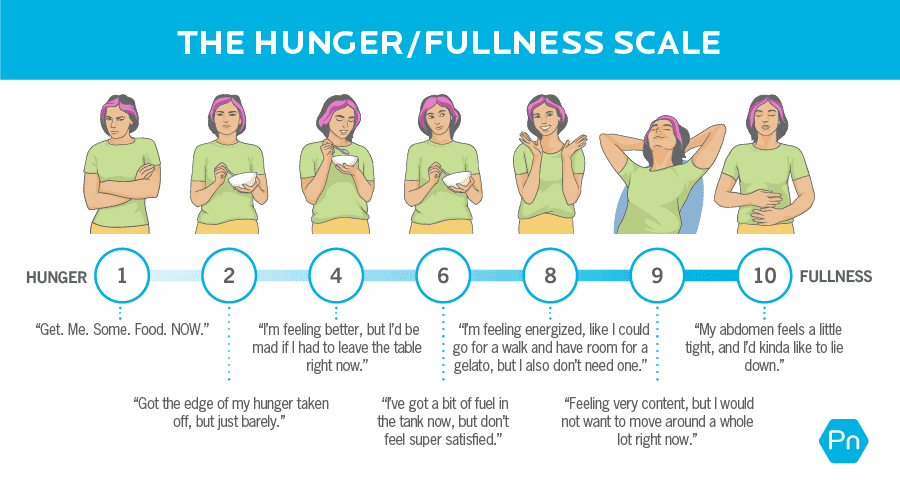
Ask your self (or your shopper): What degree of fullness feels proper to you? Some folks may wish to be at a 7 or 8 once they’re completed consuming. Others may wish to get nearer to 9 or 10.
When you battle to remain tuned in for a whole meal, attempt checking in simply thrice: through the first, center, and final bites. (In fact, the center chunk will often be approximate.)
Experiment till you determine what’s best for you.
Precept #7: Cope together with your feelings with kindness.
Intuitive consuming nudges you to ask vital questions, particularly when you end up turning to meals whenever you’re not bodily hungry. Relatively than berating your self, you gently discover what’s actually happening by asking your self:
“What do I actually want? Is it connection? Higher relationships? Am I feeling drained, harassed, pissed off?”
These questions may lead you to far more nourishing options that occur to be situated far exterior of the kitchen.
“Intuitive consuming is about being prepared to pay attention, belief, and respect your ideas and physique,” Dahl provides. “It’s not a free-for-all; it’s truly about digging deep. It takes time, endurance, follow, and self-compassion.”
One nice useful resource to get you (or a shopper) began: The Break The Chain Worksheet, which helps you study what’s actually behind experiences like stress consuming, cravings, and feeling uncontrolled round meals.
Precept #8: Respect your physique.
Cease measuring your physique in opposition to exterior requirements of the way it “ought to” look. As a substitute, attempt to settle for your physique as it’s.
In a world the place we’re bombarded with photographs of what our our bodies are “supposed” to appear to be, that is usually a problem. However it’s essential.
All our bodies are completely different, and for many people, it may be useful to simply accept that our our bodies could by no means appear to be those on the duvet of health magazines. With intuitive consuming, you’re inspired to lean into that and follow not feeling dangerous about it.
Precept #9: Motion—really feel the distinction.
Select motion that feels good to you, and that you simply genuinely get pleasure from.
Hate operating? Don’t power it. Love Zumba? Follow that.
Or possibly you don’t like purposeful exercises in any respect. In that case, you may simply concentrate on transferring your physique as a lot as doable all through the day.
Precept #10: Honor your well being—with mild diet.
Intuitive consuming is principally the other of most different approaches in relation to how they deal with the diet piece. Usually, diets concentrate on the relative well being of assorted meals and what to eat earlier than the rest.
Intuitive consuming, alternatively, intentionally does the other. You focus first on tapping into starvation and fullness alerts, emotional consciousness round meals, and physique respect.
Then you begin speaking about sensible factors like how a lot protein you want or the concept that including veggies to your meal is often an excellent transfer. And even when you think about these dietary fundamentals, you achieve this hand-in-hand with pleasure. This isn’t about forcing your self to eat nutritious meals that you simply hate. As Precision Diet tremendous coach Kate Solovieva says, “It doesn’t matter how good kale is for you, in case you hate kale.”
Who ought to attempt intuitive consuming?
With regards to selecting an consuming technique, it’s all about selecting the correct device for the best job.
So think about your (or your shopper’s) targets earlier than making a choice on whether or not to attempt intuitive consuming.
Intuitive consuming matches these targets:
✓ Enhancing your relationship with meals
✓ Recovering from disordered consuming
✓ Lowering guilt round meals
✓ Letting go of weight loss program tradition
✓ Attending to know your starvation and fullness alerts
✓ Residing in addition to you’ll be able to for so long as you’ll be able to
For these targets, intuitive consuming isn’t the only option:
✓ Purposeful weight reduction or physique composition modifications
✓ Getting ready for an athletic competitors or efficiency that has particular nutrient wants
✓ Altering the way in which your physique seems for a modeling or performing job
Caveat: Intuitive consuming ideas can profit athletes and individuals who receives a commission for his or her look when mixed with different dietary methods. However once more, intuitive consuming isn’t meant for use for purposeful weight reduction, and it alone in all probability gained’t assist them attain their targets.
An alternate: Conscious consuming
Intuitive consuming and aware consuming usually get confused, in all probability as a result of they’re comparable in some ways.
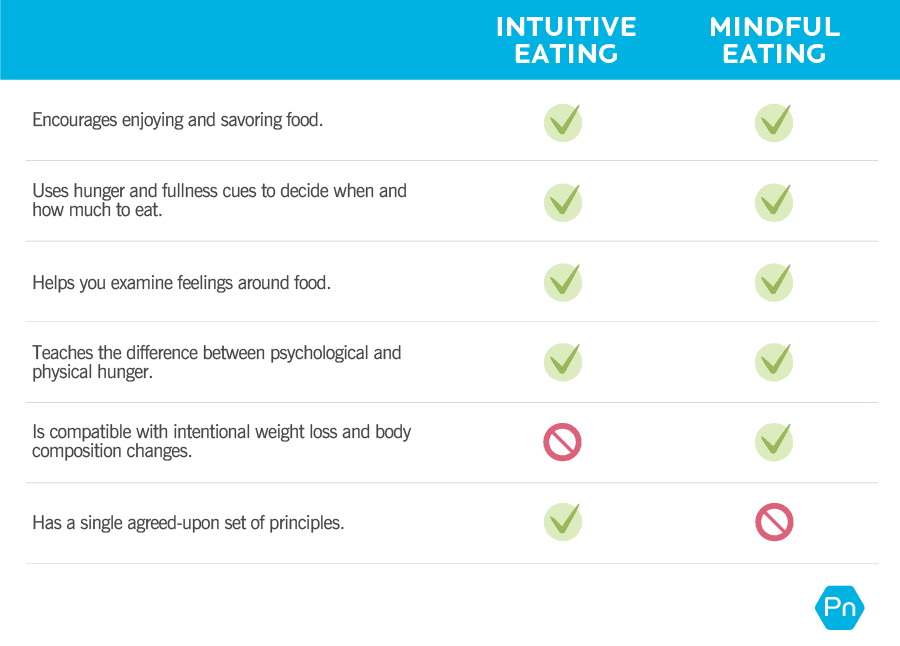
Right here’s one more various: mixing aware consuming and elements of intuitive consuming with diet fundamentals.
That’s what we do at Precision Diet. We’re agnostic in relation to one of the best ways to eat, however we do incorporate some ideas of each aware and intuitive consuming with our shoppers and in our certification.
We educate shoppers learn how to sense into their starvation and fullness, discover and identify the ideas and feelings that set off cravings, and to eat slowly and deeply get pleasure from each chunk.
As well as, we present shoppers learn how to embrace protein and veggies with meals. And for folks taken with fats loss, we clarify learn how to faucet into starvation and fullness cues to eat to 80 p.c full.
The place to go subsequent: Intuitive consuming recommendation for coaches
Whether or not or not you agree with the premise of intuitive consuming, it’s value exposing your self to the methodology, Mills says.
Except for the ebook by Tribole and Resch, you may additionally wish to try among the following assets:
Some coaches reject intuitive consuming with out actually exploring it, Mills factors out. “However it speaks to a very prevalent demographic, which is individuals who have been deeply harm by weight loss program tradition. And whenever you perceive that context, intuitive consuming makes good sense.”
When you’re a coach, otherwise you wish to be…
Studying learn how to coach shoppers, sufferers, pals, or members of the family by wholesome consuming and life-style modifications—in a method that’s personalised for his or her distinctive physique, preferences, and circumstances—is each an artwork and a science.
When you’d wish to study extra about each, think about the Precision Nutrition Level 1 Certification.
