


What if I advised you I begin my morning with a glass of lemon water?
Perhaps you’d assume:
‘Who cares?! Why does it matter what Berardi drinks very first thing within the morning?’
You wouldn’t be incorrect.
However in case you’re a sure kind of individual—the type who likes to geek out on vitamin science—it’d spark your curiosity (and possibly a bit FOMO).
Maybe you’d ask:
“Why add lemon? For digestion? Liver detoxing? Antioxidant safety?”
In different phrases:
“Does lemon include some kind of biochemical superpower I haven’t but discovered about? And, if that’s the case, ought to I be together with it myself?”
When you’re one other kind of individual—extra skeptical in nature—you may be much less curious and extra aggravated:
“Ugh—extra detoxing BS?!? Detoxing isn’t even a factor. I assumed you had been evidence-based!”
When you’re tremendous up-to-date on the newest analysis, you may even say:
“Lemons, actually? Haven’t you completed your analysis? Don’t you recognize that [enter nutrient/supplement du jour] has confirmed to be simpler?”
So, simply in case you’re questioning, right here’s the true cause I drink lemon water within the morning:
I get up thirsty. And I just like the style of lemon in my water.
(Cue anti-climactic music.)
Yep, that’s it.
That’s the large secret behind my beverage alternative.
I’m not making an attempt to assist liver detoxing or digestion.
Nor am I making an attempt so as to add antioxidant energy or alter my physique’s pH.
(I’m additionally not an “business shill for Huge Lemon.” Promise.)
I merely just like the style.
Now, if that reply disappoints you—otherwise you had been already midway to the shop to select up some lemons—you may want to listen to what I’m about to say.
As a result of I believe it’s time we cease over-nutritionalizing our meals.
Earlier than we go any additional, I’ve to confess one thing.
I’ve been responsible of the very factor I’m critiquing on this article. Actually, in case you like, you may blame the entire downside on me.
Early in my profession, I wrote A LOT, maybe an excessive amount of, concerning the biochemical and physiological properties of meals.
I churned out article after article analyzing numerous signaling pathways in fats and muscle cells, and the precise vitamins that would alter them.
Now, I didn’t intend to start out a pattern of over-focusing on the scientific properties of meals. To be trustworthy, I didn’t actually assume a lot about my intention in any respect. (That was kinda the issue).
I used to be simply actually into biochemistry and physiology.
As a PhD candidate, publishers gave me a platform to share what I used to be studying, what I used to be experimenting with (within the lab), and what I discovered intriguing.
And after I co-founded Precision Diet, I used to be in a position to attain and affect much more folks.
Alongside the way in which, readers took a cue from me.
Coaches, trainers, and fellow “vitamin nerds” fell down the rabbit gap too. They adopted my pursuits. They began specializing in the biochemical and dietary particulars of meals. And, like me, they shared their pursuits, ideas, and experiments with others.
It began a series response.
But, as Precision Diet developed, my perspective modified.
My understanding of meals broadened.
I got here to consider (as I nonetheless do) that food is not merely fuel. That no single diet is universally superior. And that there are much more issues to consuming than “how does nutrient X have an effect on pathway Y in my physique?”.
Don’t get me incorrect: Understanding the scientific properties of meals is useful—to some extent.
There’s a cause why PN teaches the science of vitamin within the Precision Nutrition Level 1 Nutrition Coaching Certification: as a result of it’s helpful to know the “why” behind vitamin suggestions earlier than you begin doling them out to shoppers.
However after I go searching as of late, I see lots of people hyper-focused on the biochemical and physiological elements of meals.
Name it over-nutritionalizing, over-intellectualizing, or over-sciencing. No matter identify you give it, it’s characterised by an virtually obsessive curiosity within the dietary and physiological elements of a given meals.
And we have to tamp that down. Or, not less than, steadiness it out.
Folks at all times ask me, “Why’d you select THAT meals / ingredient / complement?”
Typically, I share photos of what I eat on Instagram.
Both a single meal or an entire day of meals.
Persons are at all times asking me how I eat so, sometimes, I oblige by sharing my very own meals or what our family is eating.
However each time I do, the identical factor occurs: Folks ship a barrage of questions, most of them having to do with the physiological or well being worth of a selected inclusion (or exclusion). I attempt to reply the queries, however frankly, it’s arduous to maintain up.
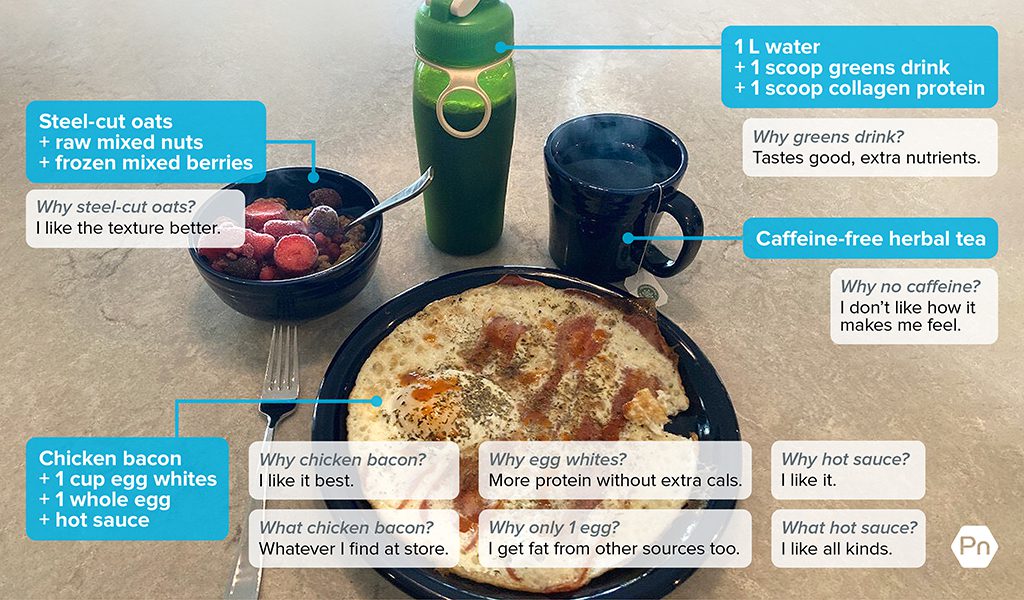
Irrespective of how a lot clarification I present, the questions maintain coming. Right here’s a sampling from current posts of varied meals.
- Why do you add lemon to your water?
- Why don’t you eat yams or brown rice or (my favourite starchy carb supply)?
- Why don’t you eat pineapple, watermelon, or (my favourite fruit)?
- Why don’t you drink milk, eat cheese, or (my favourite dairy)?
- I see you eat sauerkraut. Why not kimchi?
- I see you utilize collagen protein. Why not whey?
- You’re taking a vitamin or a protein complement or a probiotic? Which model? Which pressure? For what profit? However what concerning the analysis that claims X or Y or Z?
You get the thought.
Therefore my lemon water instance from earlier. Each time I present a meal with a glass of water with lemon, persons are deeply involved with the “well being worth” of the lemon.
In essence, it looks like every little thing the nutritionist eats MUST have a scientific cause for its inclusion.
People appear disillusioned or dissatisfied after I inform them I add it as a result of I just like the style. Or it’s considered one of my favourite meals. Or it’s all I had obtainable that day.
Equally, if I don’t embody a selected meals on a given day, like brown rice or mangoes or espresso, of us get actually wrapped up in whether or not I believe the lacking meals is in some way “dangerous for you.”
Heck, every little thing the nutritionist doesn’t eat MUST ALSO have a scientific cause for its exclusion.
However right here’s the reality:
Not each meals resolution I make is grounded in science.
Typically I eat meals as a result of I like them. (Stunning, I do know.) Or as a result of they make me really feel good. Or as a result of our kids need me to share a selected meals with them.
Likewise, I usually keep away from different meals that I don’t like. Or that make me really feel dangerous. (Yep, even the “wholesome” ones.) Or that aren’t simply accessible to me.
Right here’s an instance I posted about recently.
I’ve discovered, via the method of self-experimentation, that tomatoes and peppers appear to trigger flare-ups within the osteoarthritis that bothers my knees.
So, more often than not, I keep away from them.
Although I prefer to eat them. Although there isn’t a lot knowledge to recommend that nightshades like tomatoes and peppers are problematic. I reduce them in my eating regimen as a result of they make me really feel dangerous.
Now, simply because I’ve stopped consuming them…
Am I saying that tomatoes and peppers (or different nightshades) will have an effect on everybody with osteoarthritis?
No.
Can I let you know for certain that it’s the biochemical properties of the tomatoes and peppers that have an effect on me and never one thing else (just like the placebo impact)?
No.
Am I suggesting that different folks ought to cease consuming tomatoes and peppers?
Undoubtedly not.
They only don’t work for me.
So, what’s incorrect with nerding out on vitamin?
Like I stated, I’m a science man. There’s nothing incorrect with understanding your information.
However this hyper-nutritionalizing may be problematic in a couple of methods:
#1: Your “analysis” is probably not all that good.
It’s time to get actual about one thing.
Nutrition science is complicated, and comparatively early in its evolution. This implies there’s a good bit of analysis on the market that’s open to interpretation.
(And only a few absolute arduous and quick guidelines that apply to everyone.)
Consequently, it’s not arduous to search out analysis that justifies our personal preferences.
Think about this…
Suppose I get pleasure from a glass of lemon water within the morning. So I believe to myself, “Hmm, possibly there’s a well being profit to this. Let’s discover out.”
So I go to PubMed (the world’s largest index of biomedical analysis) and seek for scientific research that assist the usage of lemon water.
Or I Google one thing like: “well being advantages of lemon water within the morning.” (Strive it. You’ll get lots of results.)
Bingo. Now I can begin spreading the information of the virtuous lemon water—and provides myself a pat on the again for having fun with my superior morning beverage.
See the issue right here?
We’re biased. Such a “analysis” is commonly a want to justify our preferences and pure inclinations via “proof.”
That’s a harmful follow, one which breeds self-justification and a sure type of “proof blindness” to analysis that doesn’t assist one’s preferences.
It additionally alerts the top of curiosity, which is on the coronary heart of scientific inquiry.
And it occurs on a regular basis, even to good folks and good thinkers.
They let their private preferences lead their data search, as a substitute of legitimately making an attempt to resolve what people do know (or can know) a few explicit topic. Then, as soon as they’ve discovered the analysis that helps what they had been going to do anyway, they proselytize it as “confirmed” or “evidence-based.”
However “information” that was gained on this vogue is, at finest, incomplete.
At worst, it isn’t actually information in any respect.
#2: Meals is greater than its biochemical make-up. (And so are we.)
Once we get hyper-focused on the science behind our meals consumption, we miss out on different advantages of consuming, like:
- Cultural practices/traditions
- Enjoyment and pleasure
- Expressing hospitality or spending time with household and pals over a meal
- How they make us really feel, bodily or in any other case
Simply as “health” is more than “not being sick,” meals is extra than simply vitamins.
And, for that matter, people are rather more than our biochemical and physiological make-up.
Whether or not or not a meals “works for us” within the context of our every day lives has to do with extra than simply analysis.
It additionally has to do with our targets, our preferences, our life-style, our cooking expertise, our cultural background, our consuming and dwelling state of affairs, our entry to sure meals, our style buds, our social determinants of well being, and a lot extra.
Positive, there are some common dietary fundamentals that work for many of us, however that doesn’t imply that somebody is doing it incorrect if they like common complete oats to steel-cut oats.
#3: It breeds judgment and the moralization of meals.
In a recent Instagram post, I discussed that I’ve been “zero alcohol” for 3 years now and that I believe it’s contributed, in small half, to some constructive well being outcomes, significantly round hormonal well being.
This assertion was interpreted as a win for these with a “clear consuming” or “virtuous well being” or “why would you set that poison in your physique?” mindset.
Many of us gave me a digital pat on the again for this alternative—as in, “Precisely! Alcohol is poison!”
In the meantime, others took it as a private affront. Like I used to be attacking their resolution to drink.
However for me, not ingesting isn’t an ethical resolution. Or a tribal one. I personally abstain as a result of avoiding alcohol appears to assist with my autoimmune illness.
And, to be trustworthy, I by no means loved ingesting that a lot anyway. (Alcohol makes me irritable and sleepy which, alone, is annoying and, in social settings, makes me wish to go house.)
However simply because I don’t drink doesn’t imply I seek for all the data I can discover about why alcohol is dangerous for everybody after which proselytize towards it. I perceive it serves totally different wants for various folks. And that a few of these, on steadiness, may very well be wholesome… in the precise context. (For examples, try: Would I be healthier if I quit drinking?)
Backside line: I’m not anti-alcohol, nor am I pro-alcohol; I simply decided that felt finest for me. And my level right here is that this:
Another person’s meals decisions—whether or not scientifically supported or not—shouldn’t ship you right into a tailspin.
Nor ought to your private meals decisions be the idea for telling others what they need to or shouldn’t do, no matter what your self-directed scan of the analysis tells you is “proper” or “incorrect.”
If you end up doing both, it’s time to again up and acquire some perspective.
I can’t suggest a “finest meals” or a “finest eating regimen,” however I can suggest this.
Attempt to keep open-minded.
It’s as much as you to search out meals that you just get pleasure from consuming, and that assist contribute to your targets, no matter they may be.
And in case you’re a coach, it’s your job to assist your shoppers discover these meals—and people targets—for themselves.
A wholesome relationship with meals doesn’t require you to nitpick over each small resolution or have a scientific justification for every little thing you select.
Actually, when you perceive the fundamentals of how numerous vitamins work within the physique, a wholesome relationship with meals may imply the precise reverse… broadening your perspective on consuming past the “scientific advantages.”
Sure, it may well take time and follow to know what works finest for you, your physique, your loved ones, and your life-style. And to get pleasure from these meals with out overthinking them.
That’s the steadiness right here.
To acknowledge that, firstly of your “wholesome consuming journey,” you may really must spend extra time studying about your meals to assist facilitate higher, extra considerate decisions.
However then, at a sure level, you may must step again and attempt to combine that new information into the context of your actual life. To situate it inside a broader, extra strong framework for making consuming selections.
As a result of, in case you go too far right here, your concepts about meals can find yourself mired in superstition or “sciencestition.” When that occurs, it’s troublesome to be goal. Troublesome to remain curious and open-minded. Troublesome to study something, for your self or in your shoppers.
In order that’s your first experiment.
Again away from the analysis database. Make your self a meal with out overanalyzing it. And when you’re at it, pour your self a glass of water. Lemon or no lemon? The selection is yours.
When you’re a coach, otherwise you wish to be…
Studying coach shoppers, sufferers, pals, or relations via wholesome consuming and life-style modifications—in a means that’s customized for his or her distinctive physique, preferences, and circumstances—is each an artwork and a science.
When you’d prefer to study extra about each, think about the Precision Nutrition Level 1 Certification.
