


What are macros? | How to calculate your macros | How to track your macros | Macros troubleshooting and FAQs | What to eat on a macro diet | How to measure portions | Macros and consistency | Macros for weight loss | Macros and alcohol
Reduce weight, acquire muscle, and carry out higher.
However in alternate, it’s a must to do math.
Nonetheless with us?
Then perhaps you’d wish to discover ways to depend macros.
Counting macros is a technique to monitor meals consumption utilizing grams of protein, carbs, and fat (macronutrients) as an alternative of energy.
The benefit of specializing in macronutrients over energy is that it tells you a bit extra in regards to the high quality of your meals, and the way it impacts your physique.
The drawback of monitoring macros is that it’s a must to plan, measure, and report all the things you eat. After which it’s a must to do math so as to add up your macronutrient tallies on the finish of every day.
For most individuals, that may be a bit complicated and intimidating, particularly once you first get began.
That’s why we created this complete information to all the things macros.
You’ll be taught:
- What macronutrients are and what meals comprise them
- The right way to calculate and monitor your private macronutrients
- Why macronutrients aren’t the full story on the subject of well being
- Who macronutrient monitoring works finest for (and who it doesn’t)
Over 150,000 health & fitness professionals certified
Save up to 30% on the industry’s top nutrition education program
Get a deeper understanding of nutrition, the authority to coach it, and the ability to turn that knowledge into a thriving coaching practice.
What are macros, anyway?
Macros, or macronutrients, are massive teams of vitamins.
There are three principal macronutrients: Protein, carbohydrates, and fats.
(Technically, alcohol is a fourth macronutrient, however vitamin plans don’t give attention to it as a result of it doesn’t provide a lot by way of well being advantages.)
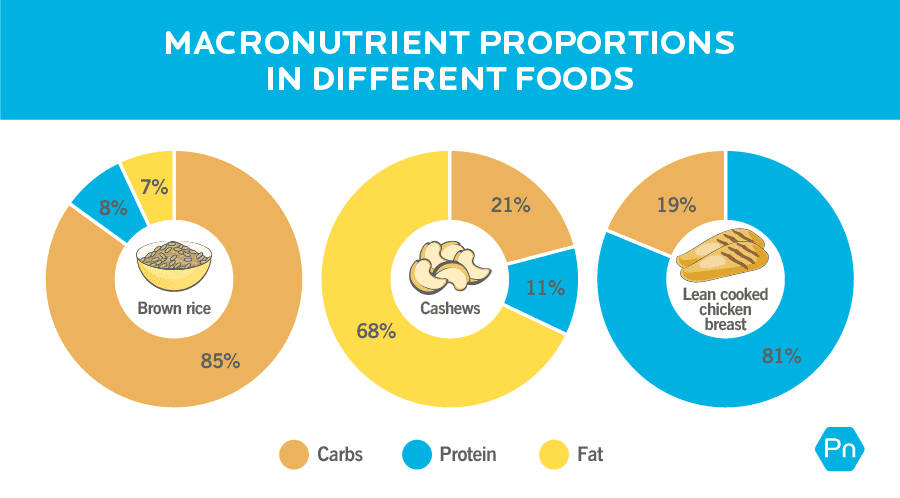
Most meals and drinks are made up of a mixture of those three macronutrients. However many meals have one dominant macronutrient that gives the vast majority of the energy.
For instance:
- Brown rice is generally carbohydrate but additionally has a little bit of protein and fats.
- Cashews are largely fats but additionally comprise protein and a little bit of carb.
- Lean hen breast is generally protein but additionally comprises some fats. It doesn’t comprise any carbohydrates.
Every macronutrient gives a sure variety of energy:
- 1 gram of protein = 4 energy
- 1 gram of carbohydrate = 4 energy
- 1 gram of fats = 9 energy
- (1 gram of alcohol = 7 energy)
Consequently, monitoring macros means you’re mechanically monitoring energy.
Why are macronutrients essential?
Your physique breaks down macronutrients to carry out particular jobs within the physique.
For instance:
- Proteins break down into amino acids, which might have an effect on our muscle composition, and are concerned in creating mood-regulating neurotransmitters.
- Carbohydrates break down into sugars, which give us vitality for quick use, but additionally storage.
- Fat break down into fatty acids, which assist kind sure constructions of our physique, like our mind, nervous system, and cell partitions.
So, along with impacting your physique weight and composition, macronutrients can impression how you are feeling, carry out, and even behave.
The right way to calculate your macros
For those who’re desperate to get your personalised macros plan, a heads up earlier than you begin:
When you get your macro numbers, you’ll wish to persist with them for at the least two weeks.
It takes that lengthy to find out whether or not any adjustments you discover are attributable to your plan working (or not working), or simply common physique fluctuations.
After two weeks, you may consider how issues are going, and modify your energy / macros up or down as wanted. The entire strategies under present estimates of your each day calorie and macro wants, so most often, it takes some experimenting earlier than you discover what works for you.
Okay, let’s crunch these numbers.
Step 1: Calculate your vitality (calorie) wants.
Macro counting is predicated on the energy in, energy out (CICO) precept: Whenever you absorb extra vitality than you burn, you acquire weight, and once you absorb much less vitality than you burn, you drop a few pounds.
(Study why CICO is indeniable: Calories in vs. out? Or hormones? The debate is finally over.)
So earlier than you’re employed out your macros, it’s a must to work out your vitality (calorie) necessities, based mostly in your physique, life-style, and objectives.
Listed below are two methods to do this.
Choice 1: Use our Macros Calculator.
There are many vitamin calculators on the market, however ours is—lowkey brag developing—particular.
Most calculators decide your upkeep calorie wants utilizing static formulation. Then, they merely chop 500 energy per day or decrease the energy 10 to twenty p.c under upkeep—regardless of how a lot weight somebody needs to lose or in what timeframe.
Our Macros Calculator does two issues which are distinctive:
- It components within the date you wish to obtain your objective by. For instance, the time you intend to take to achieve muscle or drop a few pounds.
- It accounts for metabolic adaptation. As you drop a few pounds, you burn fewer energy. As you acquire weight, you burn extra energy. In different phrases, your physique tries to compensate for weight reduction by slowing your metabolism a bit, and for weight acquire by dashing up your metabolism a bit. Different calculators don’t think about this.

How a lot do you have to eat? Let’s discover out.
© Precision Diet
To make use of it, plug in your private particulars and objectives, and also you’ll get your estimated each day calorie wants.
For those who use our calculator, you may simply skip Step 2 under. As a result of alongside together with your calorie estimates, you’ll additionally get suggestions in your supreme macronutrient ratio—or the choice to customise it your self.
Choice 2: Use the chart under.
For individuals who love by-hand calculations, we’ve received you.
First, discover your exercise stage and objective under.
Then, multiply your body weight in kilos by the corresponding multiplier.
Day by day calorie estimator
| Shopper objective | |||
| Reduce weight | Preserve weight | Acquire weight | |
| Evenly lively (<3 hrs / wk) | 10-12 | 12-14 | 16-18 |
| Reasonably lively (3-7 hrs / wk) | 12-14 | 14-16 | 18-20 |
| Very lively (<3 hrs / wk)* | 14-16 | 16-18 | 20-22 |
* Aggressive athletes—who are sometimes lively for over 15 hours per week—have even greater wants.
For instance, a calmly lively 170-pound one who needs to drop a few pounds would eat between 1,700 and a pair of,040 energy every day.
Girls ought to typically begin on the decrease finish of the vary, and males on the greater finish. Or, begin within the center and see what occurs. For those who’re not seeing the specified outcomes, modify calorie consumption up or down accordingly.
Be aware: These short-hand multipliers develop into much less correct as you progress away from “common” physique weights. For people who’re very gentle, very massive, or very muscular, our macros calculator above may be extra correct.
Step 2: Decide your macronutrient ratio.
Your macronutrient ratio (additionally known as your “macronutrient break up”) refers to how a lot of every macronutrient you’re consuming.
For most individuals, an excellent break up is 15 to 35 p.c protein, 40 to 60 p.c carbohydrates, and 20 to 40 p.c fats.
(That is only a framework. You possibly can modify these proportions in accordance with your preferences. And should you comply with a excessive fats or excessive carb weight loss plan, your numbers could go exterior these ranges.)
By adjusting your macro ratio based mostly in your age, intercourse, exercise ranges, objectives, and preferences, you may personalize your consuming plan for your optimum well being.
Use our Macros Calculator as talked about above, or the formulation under.
We’ll cowl every macronutrient one by one.
Protein
Your protein wants will rely in your weight, exercise stage, and objectives.
We calculate protein first as a result of it’s important for thus many facets of excellent well being, together with fats loss, muscle acquire and upkeep, and athletic efficiency and restoration.
Use the charts under to determine how a lot protein you want in grams per pound or kilogram of body weight.
| PROTEIN NEEDS IN G/LB | |||
| Upkeep / enhance well being | Fats loss / physique recomposition | Muscle acquire | |
| Evenly lively (<3 hours/week) | 0.6 to 0.9 | 0.7 to 1.0 | 0.8 to 1.1 |
| Reasonably lively (3-7 hours/week) | 0.7 to 1.0 | 0.8 to 1.1 | 0.9 to 1.2 |
| Extremely lively (>7 hours/week) | 0.8 to 1.1 | 0.9 to 1.2 | 1.0 to 1.3 |
| PROTEIN NEEDS IN G/KG | |||
| Upkeep / enhance well being | Fats loss / physique recomposition | Muscle acquire | |
| Evenly lively (<3 hours/week) | 1.3 to 2.0 | 1.5 to 2.2 | 1.8 to 2.4 |
| Reasonably lively (3-7 hours/week) | 1.5 to 2.2 | 1.8 to 2.4 | 2.0 to 2.6 |
| Extremely lively (>7 hours/week) | 1.8 to 2.4 | 2.0 to 2.6 | 2.2 to 2.9 |
For those who’re new to wholesome consuming or have a tough time getting protein into your weight loss plan, begin with the decrease finish of the vary.
For those who’re prepared for extra superior vitamin protocols, otherwise you’re a devoted exerciser, intention for the upper finish.
So, a 170-pound vitamin newbie who’s calmly lively and needs to lose fats would possibly select the issue 0.8 g/lb from the vary 0.7 to 1.0.
170 kilos x 0.8 = 136 grams of protein / day
A extremely lively 165-pound skilled lifter who needs to achieve muscle would possibly select the issue 1.2 g/lb from the vary 1.0 to 1.3.
165 kilos x 1.2 = 198 grams of protein / day
Be aware: For skilled athletes, lean people making an attempt to get very lean, and skilled lifters making an attempt to reduce fats acquire when including physique weight, protein necessities could go as excessive as 1.5 g/lb or 3.3 g/kg.
Fats & Carbohydrates
How a lot you eat of those two macros will depend on, properly, what you want.
First, work out what number of energy and what number of your macros you have got left over after protein.
The system seems to be like this (recall every gram of protein has 4 energy):
Whole energy – (Whole grams of protein x 4 energy) = Fats and carb energy
To get your protein share, divide energy from protein by complete energy:
Energy from protein / Whole energy = P.c of complete energy from protein
Now, subtract your p.c of protein from 100 to get your p.c of fats and carbohydrates. (Dwelling stretch, people!)
100 – P.c of energy from protein = P.c of fats and carbs
Then you may determine the way you wish to break up fats and carbs.
Listed below are some components to contemplate:
- Generally, the extra lively you might be, the larger your carbohydrate wants.
- The minimal threshold for fats is 15 to twenty p.c of complete energy.
- Analysis reveals that low-fat and low-carb diets work equally as properly for weight reduction.1
Let’s say, after an individual subtracts their p.c of energy from protein, they’ve 75 p.c of energy left over to make use of on both fats or carbs. They usually determine to do 50 p.c carbs (4 energy per gram) and 25 p.c fats (9 energy per gram).
Right here’s easy methods to do the mathematics:
Carbohydrates:
Whole energy x 0.5 = Carbohydrate energy
Carbohydrate energy / 4 = Grams of carbohydrates
Fats:
Whole energy x 0.25 = Fats energy
Fats energy / 9 = Grams of fats
Keto macros: How low carb are you able to go?
The ketogenic diet was initially developed to deal with epilepsy. Physicians found that fasting diminished the frequency of seizures, however so did an especially low-carb weight loss plan.
Ultimately, bodybuilders and health fanatics received wind of the weight loss plan and thought, ‘If the ketogenic weight loss plan mimics fasting, perhaps I can get ripped with out having to drop energy too low and lose all my gainz.’
A few a long time later, everyone seems to be consuming cauliflower-crust keto pizza. (It’s truly fairly good.)
When it comes to the macros break up, the ketogenic weight loss plan consists of about 70-90 p.c energy from fats, with the remaining 10-30 p.c of energy coming from a mixture of carbohydrates and protein mixed.
(For comparability, an ordinary “low carb” weight loss plan is about 50 p.c fats, 30 p.c protein, and 20 p.c carbohydrate.)
Until you’re making an attempt to remain in ketosis for medical causes (to scale back seizures), much less strict variations of the keto weight loss plan—which permit greater quantities of protein and carbs—are extra sustainable for most individuals, particularly athletes making an attempt to keep up efficiency and muscle mass.
(Serious about making an attempt—or teaching—the ketogenic weight loss plan? Right here’s your primer: The Keto diet plan: Your complete how-to guide.)
The right way to monitor your macros
When you’ve decided your macros, you’ll wish to monitor them to make sure that you’re assembly your macronutrient objectives every day.
Most individuals use an app like MyFitnessPal, Cronometer, or Macros+.
There are a few benefits to utilizing an app:
- You may have a fast reference information for the way a lot of every macronutrient a serving of a meals comprises
- The app will add up your macros for you (and let you understand how many you have got left for the day)
Or, you may hold monitor of your macros by hand, utilizing a paper journal and a vitamin database just like the USDA’s Food Data Central or SELFNutritionData.
With both method, report the meals you’ve eaten at every meal, together with what number of grams of every macronutrient every meals comprises.
Many individuals discover it helps to plan meals the evening earlier than or the morning of. This helps you strategize forward of time, constructing meals that meet your macro objectives, as an alternative of selecting meals reactively once you’re ravenous and—oh man, that enormous burrito seems to be good.
Most apps additionally mean you can save meals. So should you are inclined to repeat meals each as soon as and awhile, having pre-entered and -calculated meals combos could make monitoring extra environment friendly.
For those who plan on eating out, logging forward of time could be a good technique for sticking to your macros. Take a look at the menu earlier than you get to the restaurant, and do your finest to estimate the macros of the meal you’ll order.
5 frequent questions on macro monitoring
When you’ve found out your macro numbers, you would possibly really feel like you have got the important thing to all of your future well being and health objectives.
Till you truly must eat.
“Wait…how do I do that in actual life?!”
Listed below are a number of the most typical questions individuals have about monitoring macros, and what to do.
Query 1: What do you eat on a macro weight loss plan?
As you get used to monitoring your macros, you’ll be taught which meals are excessive in protein, carbs, and fats.
However one factor macronutrient counting doesn’t take into consideration is microvitamins (nutritional vitamins and minerals, often present in entire, minimally processed meals).
Micronutrients are mandatory for good well being. And although you most likely might hit your macros by crushing pizza, french fries, and protein shakes, we wouldn’t counsel it.
As a macro counter, it’s as much as you to make sure you eat a weight loss plan that meets your macro- and micronutrient wants.
One easy means to do this?
Hit your macros primarily by quite a lot of minimally processed meals which are naturally wealthy in micronutrients: lean proteins, vegetables and fruit, entire grains and legumes, nuts and seeds, and pressed oils.
For those who’re unsure the place to begin, take a look at the graphic under. You possibly can see that whereas some meals match neatly into sure macronutrient classes, different meals are extra of a combination.
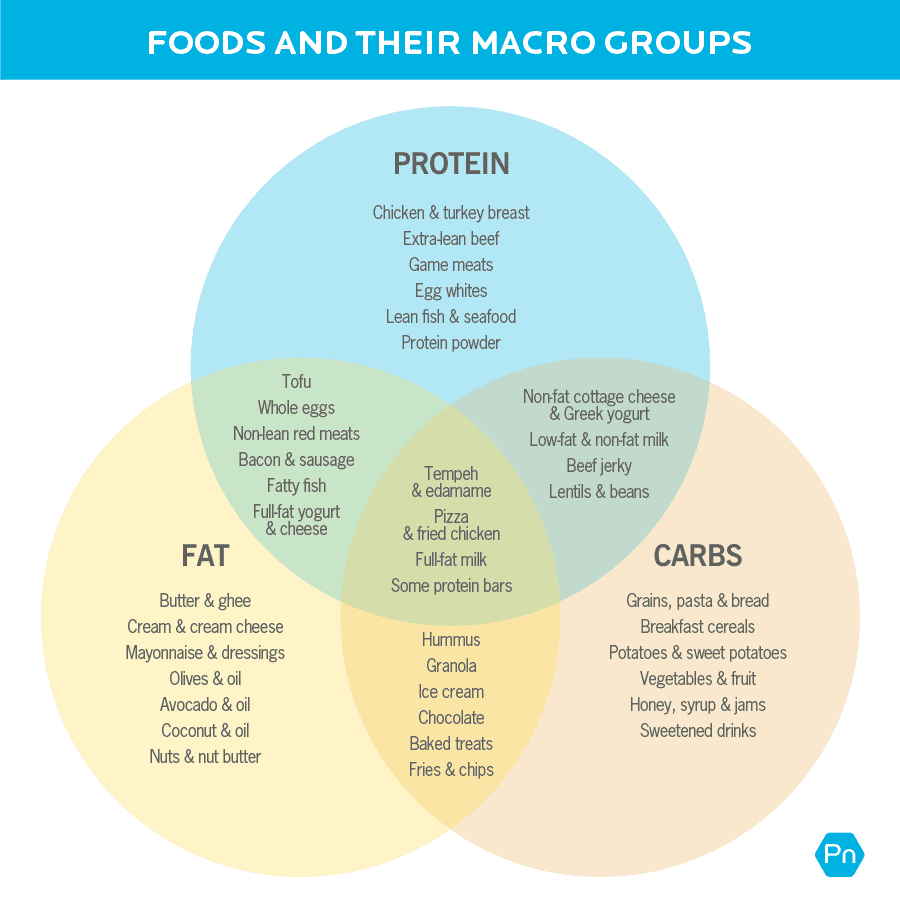
(For a extra detailed model of the above picture, take a look at our handout: The Macros Chart.)
Query 2: How do I measure my meals?
It’s not fairly Sophie’s alternative, however individuals nonetheless surprise:
Ought to I measure meals by quantity (with a measuring cup) or by weight (with a meals scale)?
Use a meals scale for one of the best outcomes. Measuring by weight will at all times be extra correct than measuring by quantity.
For instance, relying on whether or not they’re entire or chopped, a cup will match about 100 grams of almonds. But when these almonds are finely chopped, they’re simpler to pack in, and a cup could match 200 grams.
On a scale, 100 grams will at all times be a 100 grams, regardless of if the almonds are entire or chopped.
But when your solely possibility is measuring cups and spoons, that’s okay. Simply make sure—particularly to start with—to measure all the things, reasonably than eyeball it.
Folks are inclined to overestimate what a “tablespoon” or “cup” seems to be like, generally unintentionally doubling their portion.
Be aware: Cooking sure meals like grains, pasta, and meat, can change their weight and quantity. So, should you measure a meals uncooked, log it uncooked. For those who measure it cooked, log it cooked.
If weighing and measuring your meals feels tedious and soul-shrivelling, there are different monitoring choices.
For instance, you can monitor your consumption utilizing hand parts. Our Macros Calculator gives hand parts too, so that you don’t must meticulously measure all the things (except you wish to).
(Study all about hand parts right here: How your fist, palm, cupped hand, and thumb can help you avoid the hassle of counting calories.)
Query 3: How essential is it to exactly hit my macros?
Consistency will get you the outcomes you need.
However that doesn’t imply it’s a must to hit your macros precisely each single day.
For those who’re having a foul week (or yr) keep in mind that 50 p.c consistency is best than giving up utterly.
(Want proof that you simply don’t have to be good to get outcomes? Learn: One million data points show what it REALLY takes to change your body.)
For those who really feel such as you’re actually flailing, simply prioritize assembly your protein objectives every day. A weight loss plan greater in protein will assist scale back starvation, protect muscle, and assist enhance general well being.
General, intention for consistency over perfection. Attempt to get near your each day macro objectives, however don’t power your self to eat should you’re not hungry.
And should you’d reasonably have half an avocado than a bowl of oatmeal? Don’t stress about swapping fats for carbs.
Query 4: Can you utilize macros for weight reduction?
In case your objective is to lose fats, it’s a good suggestion to make use of some type of technique to trace meals consumption, at the least for a time period.
Many individuals use energy. However macros account for energy, and have the added worth of telling you a bit extra about meals high quality (like the quantity of protein, fats, or carbohydrate in a meals).
Particularly for weight reduction—the place the objective is often to lose fats however keep lean mass—monitoring macros may help make sure you get sufficient muscle-preserving protein whereas nonetheless consuming fewer energy than you burn.
Use the protein recommendations chart above to search out the protein vary in your objective and exercise stage. In case your objective is to lose fats, decrease starvation, and protect muscle mass, select the higher finish of your vary.
From there, work out your carb and fats allowances, remembering that to lose fats, it’s a must to eat fewer energy than you burn—additionally known as a calorie deficit—for a time period.
Query 5: How do I monitor alcohol?
Simply because alcohol isn’t included in typical macro plans doesn’t imply you may’t have it.
However you ought to monitor it, because it comprises energy.
The commonest means to do that is to use a few of your fats or carbohydrate grams to account for the alcohol.
For example, should you’re having a beer, 12 ounces is roughly 155 energy.2
If you wish to alternate it for carbohydrates, do the next equation:
155 energy / 4 energy per gram = 38.75 grams
So you can log your lager as 39 grams of carbs.
Or should you’re having a glass of purple wine, a 5-ounce serving is 127 energy.3
To make use of fats grams for that cup:
127 energy / 9 energy per gram = 14.1 grams
So you can log your vino as 14 grams of fats.
Or, simply use a mixture of carbs and fats, by dividing the energy nonetheless you see match and repeating the steps above.
What to do subsequent
Able to get began? Listed below are some issues to bear in mind earlier than you start.
Know what you hope to perform.
Macro counting works properly for individuals with particular objectives.
As you progress in direction of and even obtain your objective, think about if you wish to proceed counting macros. Some individuals get pleasure from counting them indefinitely, however most finally get bored with monitoring.
Fact is, macro counting is only one of many vitamin methods you may add to your toolbox.
(Need one other superior technique? Learn: The 30-day eating challenge that can blow your mind—and transform your body.)
Deal with macro counting as an experiment.
The primary macro break up you attempt would possibly work nice. Or not.
Whether or not you succeed or fail, don’t use it as a proxy in your self-worth.
Collect your knowledge, and simply see what occurs. Keep open-minded, and use the result of your experiment to tell your subsequent decisions.
Did you get pleasure from monitoring macros, and really feel nearer to your objectives? Cool! Hold going.
Did all of the measuring and counting really feel too finicky and left you wired? Strive a special means of enhancing your vitamin.
(And should you REALLY liked working with macros, you would possibly like our persevering with schooling course: How to Coach a Macros-Based Diet.)
It’s okay if macro counting isn’t for you.
Full disclosure: At Precision Diet, macronutrient counting isn’t our go-to technique of regulating meals consumption. No less than, not for most individuals.
Macro counting works—particularly for high-level, superior objectives, like getting ready for a physique competitors or a serious athletic occasion.
However even supposing macro counting will be tremendous versatile, it’s additionally lots of work. Particularly in comparison with different strategies of “watching what you eat,” which will be simply as efficient.
For most individuals and most objectives, there are much less labor-intensive methods to get outcomes. Listed below are some concepts:
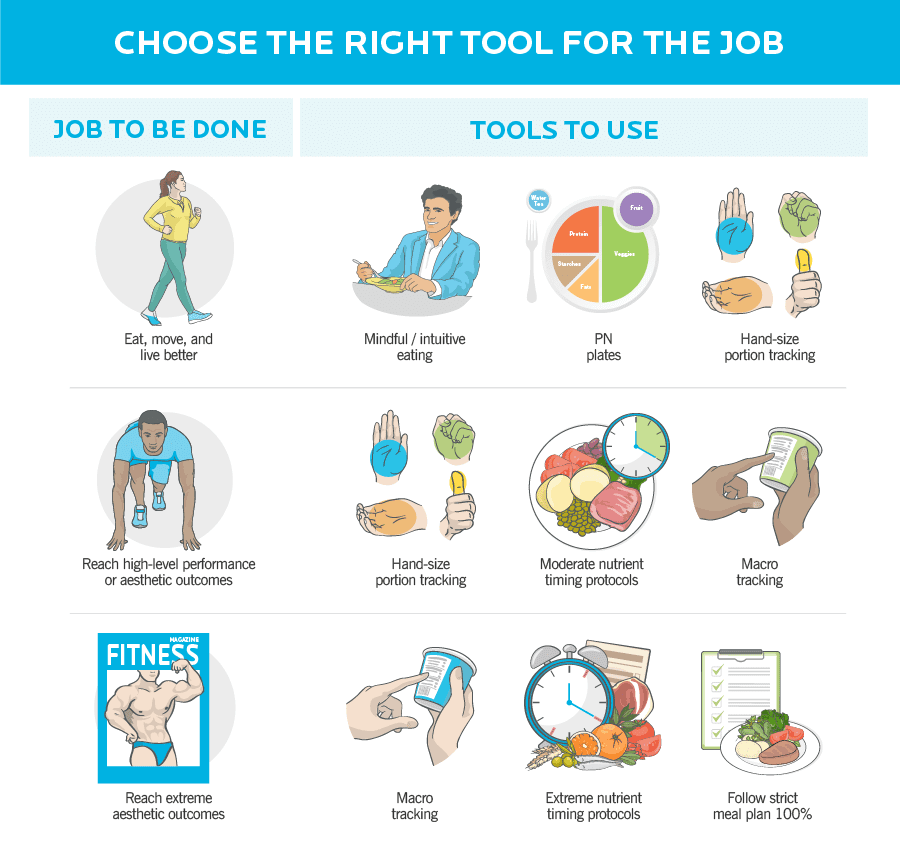 (Wish to evaluate completely different strategies of meals monitoring? Learn: Macros vs. calories vs. portions vs. intuitive eating.)
Do not forget that we eat meals, not vitamins.
Meals is a lot greater than grams of protein, carbohydrates, and fats. And meals aren’t simply an opportunity to hit your macro objectives.
Meals are additionally a possibility to expertise pleasure, spend time caring in your physique, and share with individuals you’re keen on.
Each meal is an opportunity to attach—with your self and with others. And each meals alternative is a chance to direct, form, and remake your well being.
References
Click on right here to view the data sources referenced on this article.
For those who’re a coach, otherwise you wish to be…
Studying easy methods to coach shoppers, sufferers, associates, or members of the family by wholesome consuming and life-style adjustments—in a means that’s personalised for his or her distinctive physique, preferences, and circumstances—is each an artwork and a science.
For those who’d wish to be taught extra about each, think about the Precision Nutrition Level 1 Certification.
