


“I can’t cease fascinated about meals.”
Ever felt that means?
It’s regular to consider meals a good bit, and infrequently overeat.
However what about when ideas of meals crowd out virtually every part else? While you really feel an anxiousness that’s solely relieved by consuming?
Or when it looks as if you don’t have any management over what, when, and the way a lot you eat?
It would make you surprise…
“Do I’ve an habit?”
Many people throw the phrase “habit” round flippantly after we discuss our relationship with meals.
However some individuals—together with, maybe, a few of your purchasers—are really struggling.
On this article, we’ll discover:
- What meals habit is.
- The way it’s completely different from overeating.
- Why sure meals have extra “addictive” qualities than others.
- Who’s most weak.
(Fast heads up: As a coach you’ll be able to’t diagnose meals habit, however you’ll be able to assist and be an ally to your purchasers coping with it. You’ll additionally need to refer out to a certified practitioner. Be taught extra about that here).
Let’s get into it.
Over 150,000 health & fitness professionals certified
Save up to 30% on the industry’s top nutrition education program
Get a deeper understanding of nutrition, the authority to coach it, and the ability to turn that knowledge into a thriving coaching practice.
What’s meals habit?
Meals habit means having emotionally-driven, persistent, and uncontrollable urges to eat—even if you’re not bodily hungry.
It impacts 2-11 % of individuals in Western nations. (The charges are highest within the US, with some analysis displaying as a lot as 11.4 % of the inhabitants may very well be affected.)1
With charges so excessive, you doubtless know somebody with meals habit. Or possibly you’re the one struggling.
How have you learnt?
Listed below are some indicators of meals habit:
- Craving more and more giant quantities of (normally) high-calorie processed meals to be able to really feel pleasure, power, or pleasure, or to alleviate adverse feelings, bodily ache, or fatigue.
- Spending a lot time fascinated about and getting meals, and recovering from overeating, that it crowds out leisure actions, skilled obligations, and relationships.
- Persevering with to overeat regardless of adverse results like digestive issues, undesirable weight acquire, or mobility points.
- Experiencing withdrawal-like results—irritability, low temper, complications or fatigue1,2—if you’re not consuming.
How is meals habit completely different from different types of overeating?
In the event you overeat at most of your meals, or have the occasional out-of-control binge consuming episode, are you hooked on meals?
Not essentially.
Just about everybody experiences intervals of overeating, and/or situations of binge consuming.
As the next continuum exhibits, it’s solely when urges and compulsive habits round meals turn into extreme, frequent, and continual that an individual may be recognized with an consuming dysfunction or meals habit.3,4,5
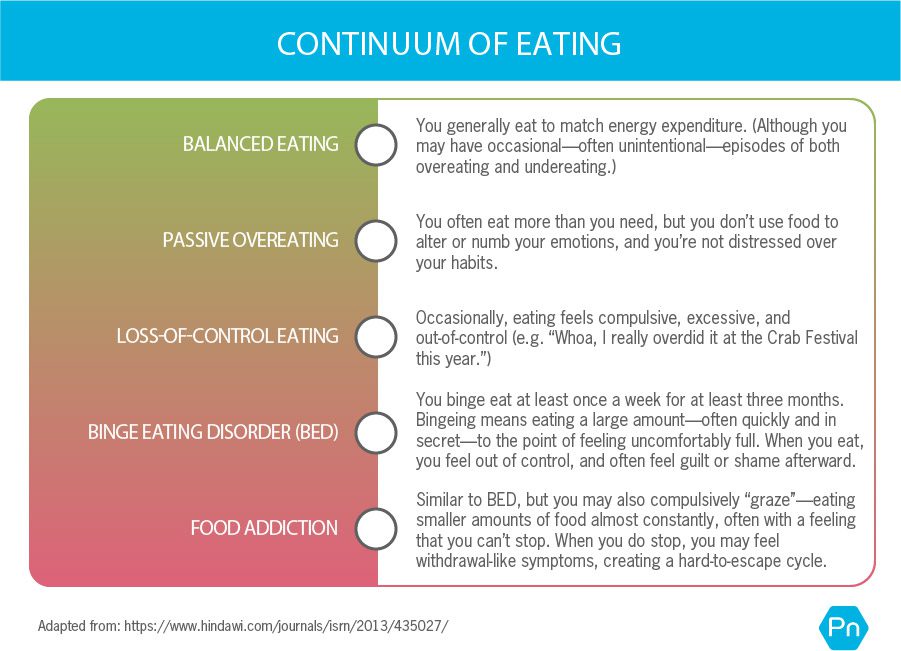
As it’s possible you’ll discover, binge consuming dysfunction and meals habit share a number of main similarities.
However meals habit—which extra intently resembles a substance use dysfunction—is extra extreme than BED as a result of it causes much more life disruption.
How meals habit occurs
Meals habit isn’t attributable to one single factor.
For instance, you’ll be able to’t simply blame it on genetics.
Elements like the quantity of stress in somebody’s life, how they reply to that stress, how lonely they really feel, the place they stay, and who they spend time with additionally make an influence.
In different phrases, like most well being points, meals habit arises out of a jumble of organic, psychological, and social components. (This multi-dimensional method to understanding sickness and well being known as the biopsychosocial perspective.)
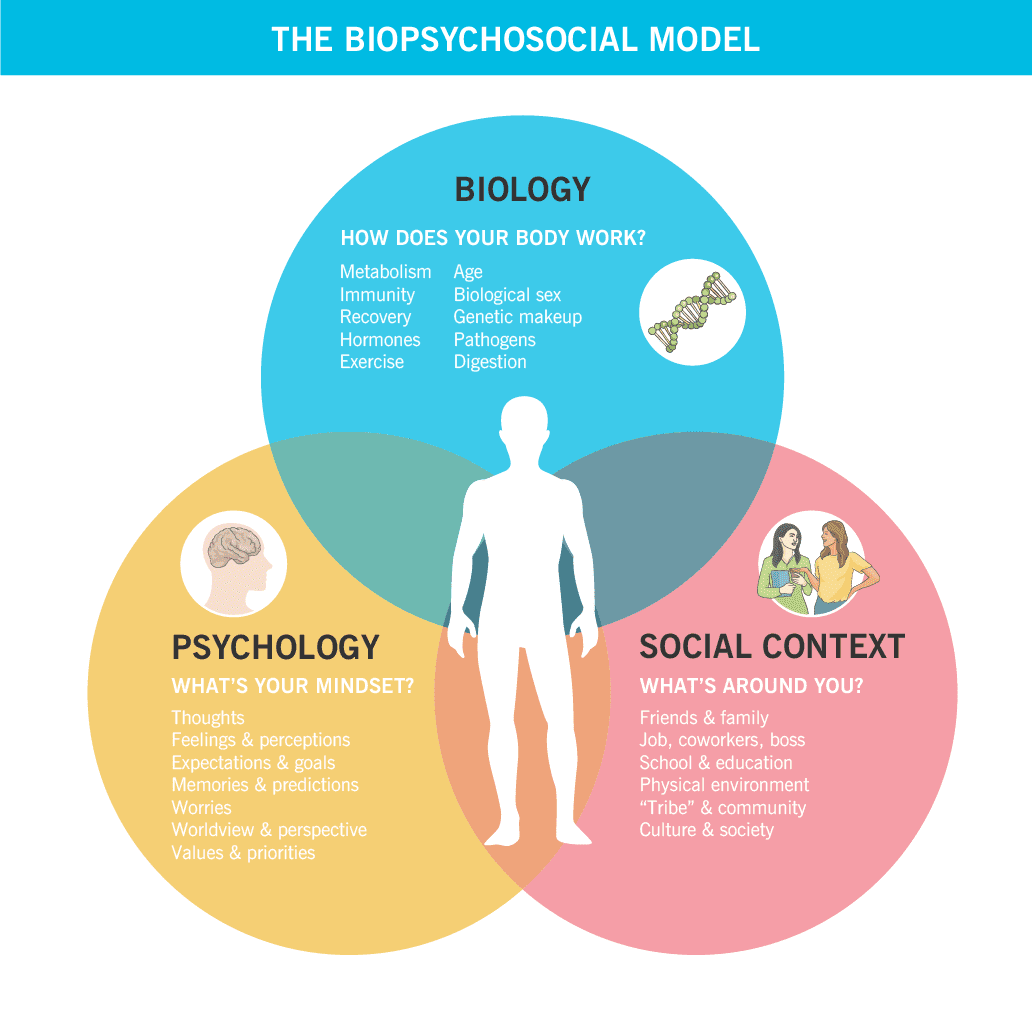
Let’s go into these classes now.
Organic components: How does your physique work?
In early human historical past, meals shortage occurred on the common.
To outlive, people developed to overeat when meals was considerable, particularly when that meals was tasty and calorie-rich.6,7,8 (Jackpot: avocado tree.)
However now, the intuition that after helped us survive makes it arduous to cease consuming.9
Extremely-processed meals—particularly these with a mix of sugar, fats, and salt—are probably the most tough to withstand.
Very like medicine and alcohol, these meals set off a spread of rewarding, feel-good neurochemicals, together with dopamine. Extremely-processed meals have this impact even if you’re not hungry.10,11,12
(In distinction, complete, unprocessed meals aren’t very rewarding if you’re not hungry, and it’s normally simpler to average your consumption of them.5,13)
Nowadays, highly-processed meals are so accessible that you must depend on your skill to self-regulate, or management your habits, so as to withstand them.
However individuals who cope with compulsive overeating (together with these with meals habit) typically have a tough time self-regulating.
Right here’s why:
Folks with compulsive overeating might…
▶ Wrestle with impulse management, probably as a result of the planning, strategizing middle of the mind (the prefrontal cortex) is impaired. This is likely to be a trademark of all addictions, and may contribute to poor restoration outcomes.14,15
▶ React extra simply and intensely to stressors. They’ve a better stage of cortisol launch than others.16 And since stress can set off addictive behaviors, people who find themselves extra bodily delicate to emphasize could also be extra doubtless to make use of meals (or medicine or alcohol) as a solution to cope.
▶ Get extra pleasure from meals (at first).17,18 They might have an even bigger dopamine response to highly-processed meals, extra motivation to hunt out that response once more, and stronger cravings.19
▶ Get much less pleasure from meals over time. While you typically overeat highly-processed meals, dopamine receptors turn into much less attentive to these meals.20 Which means that an even bigger “hit” of meals is required to attain the identical pleasurable impact.21,22,23
Dopamine: Why we prefer it, and the way it hooks us.
Dopamine launch occurs within the nucleus accumbens, a mind area well-known for its position in registering pleasure and reinforcing studying.5
Numerous issues offer you little dopamine boosts… consuming a tasty meal if you’re hungry, connecting with associates and family members, and attaining objectives. Nevertheless, sure actions and substances—like medicine, playing, and (sure) highly-processed meals—can produce unnaturally excessive surges of dopamine.
Right here’s why that may turn into an issue:
The larger the dopamine response, the extra pleasure you expertise. The extra pleasure you are feeling, the extra motivated you might be to repeat it.
While you expertise a dopamine surge, you study to affiliate pleasure with the particular exercise or substance that brought about it.
As that studying continues, your prefrontal cortex and your reward system get hijacked. You turn into targeted on getting extra of the factor. And you’ve got hassle experiencing pleasure from the rest.
Over time, your mind adapts to those floods of dopamine.
That is referred to as tolerance. Tolerance drives you to chase extra of the pleasurable factor, but you hardly ever really feel glad.
That is the habit cycle.
(Wish to know extra about what meals traits individuals discover irresistible—and even addictive? Learn: Manufactured deliciousness: Why you can’t stop overeating.)
Psychological components: What’s your mindset?
After we ask purchasers, most of them say they’re extra prone to overeat once they’re feeling careworn, drained, or unhappy.
Analysis helps this remark: Stress, depressed temper, anger, boredom, and irritability are frequent triggers of binge consuming.16,24
Binge consuming typically additional triggers emotions of guilt and disgrace, and these emotions might promote extra addictive behaviors.25
As a result of binge consuming and meals habit are related to challenges regulating feelings,26,27 meals can be utilized as a solution to self-medicate and quickly really feel higher. (Meals with candy tastes are particularly efficient at elevating temper and suppressing ache.28)
Meals habit can also be related to a historical past of trauma and abuse, and is discovered alongside quite a few different psychological well being problems like melancholy, consideration deficit/hyperactivity dysfunction (ADHD), psychosis,29 and post-traumatic stress dysfunction (PTSD).30
(Wish to assist purchasers with trauma whereas staying in your scope? Learn: How trauma affects health and fitness—and prevents client progress)
Though many individuals consider addictive consuming as a type of “self-sabotage,” right here’s a extra compassionate, helpful means to consider it:
For the individual struggling, meals is solely a secure place, a consolation to show to when life feels overwhelming.
Social components: What’s round you?
In animal analysis, addictive consuming behaviors solely occur once they’re given highly-processed meals.5
This isn’t to say that processed meals trigger addictive consuming. It’s simply that their presence, mixed with different organic and psychological vulnerabilities, makes meals habit extra doubtless.
And because of social components, some individuals are uncovered to highly-processed meals extra typically than others.
Think about you reside in a “meals desert”—an space that has poor entry to reasonably priced, recent, and minimally-processed meals. If all you will get at your native grocery retailer is packaged snack meals, white bread, and possibly some canned fruit, your vitamin and urge for food will likely be tougher to handle.
Equally, not having sufficient cash to purchase wholesome meals frequently could make an influence. Naturally, you would possibly do like our ancestors and “refill” when energy can be found. Some analysis helps this: Increased charges of meals insecurity are related to disordered consuming behaviors like binge consuming.31
You can even choose up on social cues round meals.
In the event you’ve grown up with family and friends that recurrently overeat, or use meals to appease, consolation, or entertain, they could encourage you (explicitly or implicitly) to do the identical.
Even if you need to alter, swimming in opposition to the present may be arduous.
The irony of food plan tradition
Regardless of some progress by actions like physique positivity and “Well being at Each Measurement,” fashionable tradition nonetheless prizes thinness.
As a way to obtain that thinness, many individuals food plan incessantly.
Right here’s how that backfires:
While you assume you’ll be able to’t have entry to one thing (on this case, meals you discover scrumptious), you find yourself wanting extra of it.
That is referred to as the restricted entry paradigm, and it explains why very restrictive diets not solely typically fail, however might even make individuals extra prone to overeat and binge eat.32
[Facepalm.]
That’s why restoration from compulsive overeating and meals habit typically focuses on physique consciousness, aware consuming, and creating a constructive relationship with meals—not weight-reduction plan.
All for checking your bias in the direction of thinness as a coach? Learn: Are you body-shaming clients? How well-meaning coaches can be guilty of “size-bias.”
Assist with meals habit: 3 methods to assist purchasers (or your self)
Well being and vitamin coaches can’t diagnose or deal with a meals habit, or any type of consuming dysfunction. However you can begin the dialog, and be an important a part of a consumer’s restoration crew.
In the event you’re studying this text as a result of you’re struggling, we’ll counsel some methods to assist your self too.
1. Create a secure, compassionate, and inspiring surroundings.
If a consumer involves you with some deep stuff, don’t really feel like you must work out their childhood or repair their biology.
As a substitute, concentrate on understanding their present scenario, serving to them really feel secure, and creating a trusting relationship.
One of the best methods to do this? Apply empathy and energetic listening.
(Learn extra about empathy and listening abilities: “I’m a coach, not a therapist!” 9 ways to help people while staying within your scope.)
As a result of individuals with meals habit and binge consuming dysfunction could also be extra delicate to reward,33,34,35 coaches also can assist “reward” purchasers in additional affirming methods.
That means: Give them plenty of reward. Have fun each “win” you see.
And if a consumer involves you feeling disgrace over a sure habits or feeling, reassure them that this isn’t proof of their inadequacy. Missteps and imperfections are human. Feeling delicate to them is only a signal that they need to do higher for themselves.
In the event you’re scuffling with meals habit:
You’ll profit from self-compassion and non-judgement too. Strive to not blame or criticize your self for “inflicting” this or “being too weak” to drag your self out of it.
Be your individual buddy: Individuals are significantly better at altering once they come from a spot of affection and assist.
For extra sensible, self-compassionate methods to really feel higher, learn: “How can I cope RIGHT NOW?” These self-care strategies might help you feel better.
2. Drop the vitamin lecture.
Sure, possibly you’re a well being or vitamin coach.
However on this case, focusing an excessive amount of on vitamin (particularly energy and power consumption) can backfire.
Purchasers scuffling with meals habit are normally already overly involved with what and the way a lot they’re consuming—they usually in all probability really feel great disgrace round that.
➤ As a substitute of dietary worth, concentrate on how meals make purchasers really feel.
You may ask (with kindness and real curiosity): “While you eat [insert trigger food], how do you are feeling in your physique? And what ideas come up?”
Though generally uncomfortable, this train may help purchasers establish meals that do really feel good of their our bodies, and align with their values. Over time, this could construct a extra constructive, sensible relationship with meals.
➤ Assist purchasers develop consciousness round their triggers.
Ask gently: “What was occurring earlier than you began to really feel the urge to eat? The place have been you, who have been you with, and the way have been you feeling?”
While you’re conscious of your patterns and habits, it’s simpler to search out alternatives to re-route them.
(Right here’s a worksheet that helps purchasers establish and disrupt unproductive consuming habits: Break the Chain worksheet)
➤ Collaborate to give you eating-replacement actions.
Stress is a standard set off for overeating, so ask your consumer to make an inventory of actions that calm them down, and convey them pleasure.
Notice that overeating isn’t “forbidden.” Purchasers at all times have the choice to make use of this coping mechanism.
However they will additionally slowly develop different behaviors to consuming—which they might study to favor over time.
In the event you’re scuffling with meals habit:
Listed below are three small actions you’ll be able to take to start out serving to your self really feel higher:
- Concentrate on how meals make you are feeling moderately than their caloric worth.
- Use the Break the Chain worksheet to develop consciousness of your triggers.
- Create your individual private listing of substitute actions.
3. Refer out.
In the event you suspect your consumer has meals habit, it’s possible you’ll need to begin with this worksheet: The Yale Food Addiction Scale. Whilst you can’t diagnose your consumer (until you’re additionally a certified psychological well being or medical well being skilled), you should utilize this software to start a dialog.
Most significantly, empower your consumer to hunt assist exterior of your teaching. Remind them that looking for skilled assist takes braveness and knowledge, and that you just’ll be with them alongside the journey.
For most individuals, a household physician is an effective place to start out. Household docs can carry out a proper evaluation, then discuss with acceptable assist, whether or not that’s a licensed therapist, a psychiatrist, or one other well being skilled.
In case your consumer needs assist discovering a therapist, discover one which’s educated in cognitive behavioral remedy (CBT), which has been proven to be efficient in managing and treating addictions and disordered consuming.
You is likely to be the primary (and solely) individual your consumer has confided in.
Take your position critically, show acceptance and compassion, and assist your consumer get the care they deserve.
In the event you’re scuffling with meals habit:
You’re not alleged to do actually arduous issues by your self. It typically takes a crew of assist, so attain out.
Speak to a trusted liked one for ethical assist, and seek the advice of your loved ones physician or a licensed psychotherapist to get skilled assist.
Asking for assist doesn’t make you weak. It means you will have your individual again.
References
Click on right here to view the data sources referenced on this article.
In the event you’re a coach, otherwise you need to be…
Studying learn how to coach purchasers, sufferers, associates, or relations by wholesome consuming and way of life adjustments—in a means that’s personalised for his or her distinctive physique, preferences, and circumstances—is each an artwork and a science.
In the event you’d wish to study extra about each, take into account the Precision Nutrition Level 1 Certification.
