


“Is it burnout, or am I simply being a child?”
Burnout is gaining recognition within the work and wellness worlds. This is sensible, as self-reported stress ranges are increased than ever.1 (And world pandemic, you’re actually not serving to.2)
However, like many well being situations, particularly these associated to psychological well being, there’s nonetheless a good bit of stigma round burnout.
Some individuals hear the time period “burnout” and say:
“This wasn’t a factor after I grew up. When did individuals turn into allergic to arduous work?!” (As they take an enormous gulp of their mid-morning bourbon.)
Reality is, burnout is nothing new.
It’s been round as a medical idea because the Seventies, and it certainly existed earlier than we slapped a proper title on it.3
However in 2019, the World Well being Group formally acknowledged it as a office phenomenon, and are at present engaged on growing instruments to assist acknowledge, deal with, and most significantly, forestall burnout in workplaces.4
That’s excellent news as a result of: Realizing you’re burned out additionally means you may get well from it sooner—and higher.
Plus, stopping burnout often means enhancing general wellbeing.
On this article, we put collectively a helpful quiz that will help you spot the indicators of burnout—both in your self or in shoppers. (If you wish to leap to it, click here.)
After that, we’ll share 3 ways to counteract burnout—even in case you can’t make stress “go away.”
Prepared? Let’s dig in.
++++
What’s burnout?
Burnout, also called burnout syndrome, is a state of psychological, emotional, and bodily exhaustion that may occur when the calls for in our lives constantly and chronically outweigh what we’re in a position to do or produce.5,6,7
It’s not a single dangerous day—and even week—at work. Reasonably, it’s an ongoing, lengthy standing sample of feeling such as you’re attempting and failing, with out success, assist, recognition, or restoration.
In most nations, burnout isn’t thought of a medical situation, however moderately an occupational (office) phenomenon.
That mentioned, some locations (hello, Sweden and the Netherlands), do acknowledge burnout as a medical prognosis that requires break day from work.
People most in danger for burnout have jobs the place:
- Precise calls for are excessive (fast-paced work, excessive stakes, a number of selections, vital penalties for errors)
- Perceived calls for are excessive (it feels rushed, overwhelming, pressing, and busy—particularly for individuals who care about “doing an excellent job” or “being a workforce participant”)
- Beliefs are excessive (individuals have excessive private requirements and strongly imagine within the worth and significance of their work)
- Sources are low (similar to time, cash, assist, and relaxation)
While you consider this mixture, you may already be imagining who feels it most: service jobs like well being care, first response, educating, or teaching are prime examples of occupations with excessive charges of burnout.
However burnout can have an effect on individuals in any profession. And despite the fact that it stems from work, burnout’s shockwaves can impression all areas of your life.
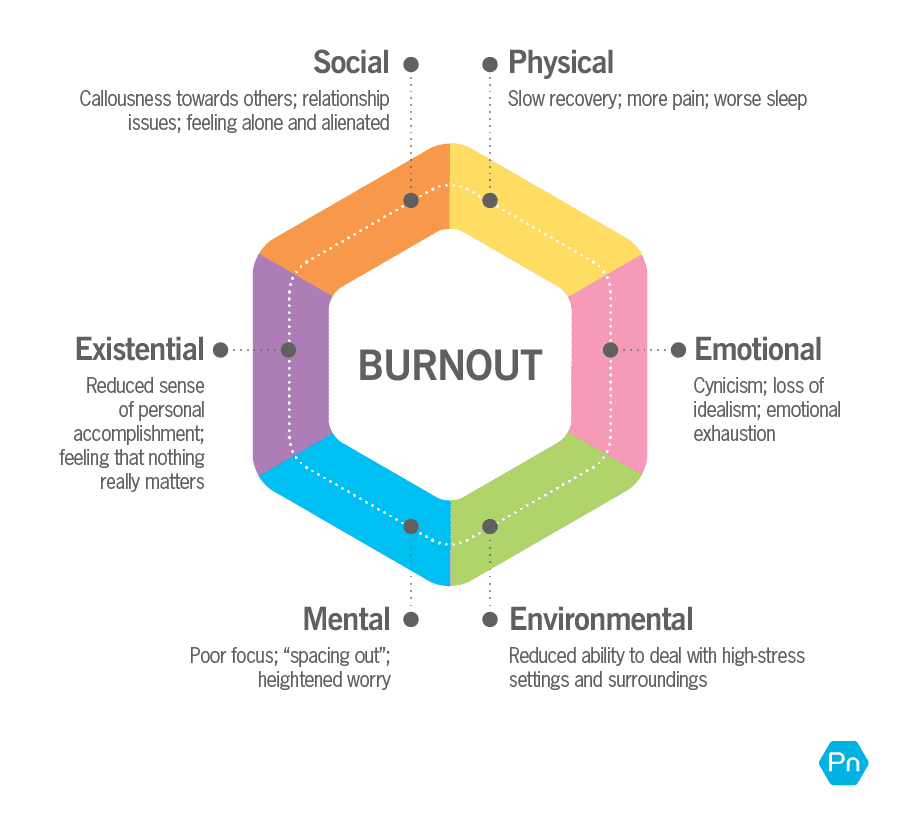
Fortunately, restoration may come from many areas of your life. We’ll get to that half in only a minute.
Burnout check: Are you exhibiting indicators of burnout?
For every assertion that feels like one thing you expertise comparatively usually, tick the field.
On the finish of the quiz, you’ll get a rating.
Generally, the extra indicators you expertise, the extra probably you’re to be on the highway to burnout. (Take a look at the ideas we provide on the finish of this text.)
Necessary: This isn’t a medical diagnostic check.
In case you’re noticing various of the under, even when it doesn’t really feel like a “massive deal,” take into account consulting a healthcare skilled.
Sleep, fatigue, and power ranges
- Hassle falling or staying asleep – 1 level
- Poor high quality sleep (e.g., stressed, get up usually) – 1 level
- Drained (so, so drained); run down and drained – 1 level
- Wired… can’t sleep! Operating on an invisible hamster wheel! – 1 level
- Depend on caffeine for alertness via the day (e.g., espresso, black tea, power drinks, caffeine tablets) – 1 level
- Physique feels heavy or sluggish – 1 level
Bodily signs
- Coronary heart palpitations, racing coronary heart – 1 level
- Tightness in chest or hassle respiration – 1 level
- Abdomen upset, digestive points (e.g., heartburn, gasoline, irritable bowel) – 1 level
- Complications, migraines – 1 level
- Jaw ache/tightness; tooth grinding (dentist may discover this in case you don’t) – 1 level
- Jumpy, startle simply – 1 level
- Persistent aches and pains (e.g., muscle aches, infected joints, again or neck ache) – 1 level
- Irregular, painful, and/or absent menstrual cycles (in case you have a uterus and would usually be menstruating) – 1 level
- Feeling spaced-out or dizzy – 1 level
- Starvation and meals cravings; emotional consuming – 1 level
- Lack of urge for food – 1 level
- Poor immunity—you appear to get each bug going round or simply really feel sort of “off” a lot of the time – 1 level
- Poor restoration—takes longer to get well from exercises, accidents don’t heal as effectively, appears arduous to bounce again – 1 level
- Infected (e.g., flare-ups of allergic reactions, pores and skin points, joint ache, sinusitis) – 1 level
- Hair falling out – 1 level
Cognitive / psychological signs
- Forgetful or usually fear about forgetting issues – 1 level
- Arduous to pay attention or focus – 1 level
- Really feel anxious and/or fear quite a bit – 1 level
- Really feel overwhelmed, and/or frazzled—a lot to do/juggle! – 1 level
- Procrastinate and/or keep away from duties – 1 level
- Arduous to prioritize duties or select what’s essential to do subsequent – 1 level
A number of of those ideas appear acquainted:
- “Everybody else is the issue. They’re so unmotivated/cussed/lazy/loopy.” – 1 level
- “My boss/office is the issue.” – 1 level
- “Every part round me is damaged. Nothing works proper. I hate ____.” – 1 level
- “That is all out of my management. So many issues should be mounted, but it surely’s not my job to do it.” – 1 level
- “I simply maintain attempting and attempting, but it surely’s like being on a hamster wheel. I by no means get anyplace.” – 1 level
- “I’m nice. That is nice. It’s all nice. I’ll simply deal with it like I all the time deal with it. Nice. Nice. I’m completely nice.” – 1 level
- “AAAAAAAAAAAAAHHHHH!!!!” – 1 level
Emotional signs
- Really feel “clean”, impassive, numb – 1 level
- Really feel unhappy or “down” – 1 level
- Really feel trapped and caught, out of choices – 1 level
- Really feel pessimistic, discouraged, hopeless, “what’s the purpose” – 1 level
- Really feel resentful, irritable, short-tempered – 1 level
- Really feel chronically annoyed; all the things round you sucks and individuals are jerks – 1 level
- Really feel disconnected, alienated, alone – 1 level
- Really feel like no person acknowledges or appreciates you and/or your work – 1 level
- Appears like nothing you do or are is sweet sufficient – 1 level
- Looks like almost day by day is a tough day – 1 level
- Feels such as you want one thing to manage (e.g., medicine, alcohol, consuming/not consuming, purchasing) – 1 level
- Typically centered in your shortcomings (e.g., not match sufficient, not ok, not good sufficient, not organized sufficient) – 1 level
- Really feel uncontrolled – 1 level
- Making an attempt very arduous to manage different issues—like your physique, different individuals, your routine—but it surely feels such as you’re failing – 1 level
Relationship signs
- Can’t relate to or join with different individuals, similar to household, mates, coworkers, shoppers, and so forth. – 1 level
- Keep away from others (e.g., procrastinate contacting shoppers, maintain workplace door closed to different individuals, similar to household, mates, coworkers, or shoppers) – 1 level
- Really feel like you may’t rely on or belief different individuals (they screw issues up or allow you to down) – 1 level
- Lively conflicts with others at work, house, faculty, and so forth. – 1 level
Your burnout rating:
Rating: 3 or much less
Sounds such as you’re doing alright. You might have an occasional dangerous day, however you get well from it, and transfer on.
Rating: 4 to eight
Hmm. You may profit from slightly extra restoration and self-care. Contemplate consulting a professional psychological well being skilled, even only for a chat.
Rating: 9 to 13
Watch out—you’re susceptible to burnout, significantly in case you really feel a number of of those intensely and sometimes. Contemplate consulting a professional psychological well being skilled.
Rating: 14 to 18
You might be at extreme danger of burnout. Do one thing about this urgently. Search assist and assist from a professional skilled.
Rating: 19 or extra
You might be at very extreme danger of burnout. It’s time to take motion and search assist and assist from a professional skilled.
3 methods to counteract burnout syndrome
Whether or not you scored excessive and are on the lookout for an answer, otherwise you’re curious what to do in case you’re involved about burnout creeping up on you sooner or later, right here’s what can assist.
(And in case you’re working with a consumer exhibiting burnout signs, you’ll undoubtedly wish to share these methods with them.)
#1: Shield your time, house, and emotional funding with good boundaries.
Boundaries, or the shortage of them, are a key think about burnout.8
This may be boundaries between:
- Dwelling and work (for example, struggling when working remotely, discovering your self doing work exterior of labor hours… or in your mattress)
- Private {and professional} identities (by chance venting about private stuff to a consumer, or being requested to do work that’s exterior the scope of your job)
Conversely, having clear, sturdy, and well-defined boundaries can alleviate burnout by:
- Serving to you swap “work mode” on and off.
- Defending time with mates and family members.
- Lowering the quantity of emotional labor you’re doing.
(Emotional labor means managing different individuals’s emotions, in addition to controlling your personal emotional response to them. Study extra: Invisible stressors: Are they sucking the life out of your health?)
How do you keep good boundaries? Listed below are a number of concepts.
▶ Establish what you may and might’t management. Attempt our Sphere of Control Worksheet.
▶ Implement a “focus filter.” Consciously inform your self, ‘I’m selecting to give attention to THIS proper now.’ This is applicable to work—you don’t do home tasks or counsel your mother-in-law whilst you’re attempting to do your job—however it will possibly additionally appear to be spending time together with your accomplice with out excited about work as you gaze throughout a candlelit desk.
▶ Be intentional about your setting. If distant working muddles your work-life boundaries, arrange a separate house for work-related duties—even when it’s a selected nook of your kitchen desk or the center seat of your sofa.
As a result of as enjoyable as it’s to take convention calls from mattress in your housecoat, creating separation between “work” and “house” will make turning off “work mode” and moving into “relaxation mode” on the finish of the day really feel a lot simpler.
(Plus, in case you can go someplace and shut a door, it’d—barely—cut back your “on-call” standing for different members of the family. Cue: “MOM!! Billy is touching my Tonka truck together with his Lego!!”)
▶ Make clear your boundaries—what you’re saying “sure” and “no” to at a given time. Perhaps you inform your self you wish to say “sure” to household time (or plain previous sanity time for your self), so that you’re not checking emails after 6 pm.
You might uphold that boundary by placing your telephone on mute, so that you don’t hear emails pinging as they arrive in.
▶ Talk your boundaries clearly to others, and implement them as wanted. Inform others what your boundaries are. Be express and clear. Don’t anticipate of us to “simply know.” (As Brené Brown says, “clear is form.”)
It may be uncomfortable to advocate on your wants, but it surely’s kinder to your self—and the opposite particular person—to be trustworthy about what you may and might’t maintain. In our work e mail scenario, which may imply placing on an auto-responder that lists your workplace hours, so individuals know when to anticipate to listen to again from you.
▶ Bear in mind, it’s not simply in regards to the “no.” It’s additionally in regards to the “sure.” As in, what have you ever consciously determined is value your time, power, and a spotlight?
What actions are aligned together with your values? What do you wish to do and really feel extra of? What must be cleared, constrained, or revised as a way to prioritize higher, and “replenish your tank” extra successfully?
#2: Domesticate engagement by spending extra time on what you like doing, with individuals you like working with.
The flip aspect of burnout is engagement.9,10
Engagement means you’re thriving in your work function. You’re energized by your work, and the individuals round you assist you and respect your boundaries.
Charges of burnout are decrease in workplaces that target the next six engagement-promoting elements:11
- Applicable workloads
- Management over work (no less than slightly)
- Rewards, together with easy appreciation and recognition
- Neighborhood and real, supportive social connections
- Equity and fairness
- Values that really feel significant
In fact, in case you’re an worker, you could not have management over whether or not or not your job has all these elements. However you can:
▶ Speak to your supervisor about workload, what you wish to work on, and the way you’d prefer to obtain suggestions. Reasonably than attempting to do all of the issues like a hero, ask for assist prioritizing, if wanted.
▶ Construct sturdy connections. Make investments time in relationships that really feel real and supportive. If attainable, join with colleagues… and in addition have relationships which have nothing to do with work.
▶ Contemplate your values. What issues to you? Take into consideration what your private values are, and the way they align with the work you’re doing. Have your values modified? Or do you simply want extra assist discovering a match between job calls for and what you really really feel is essential?
▶ Mannequin productive, collegial, and growth-oriented habits. Many groups bond over a shared hatred of workloads, shoppers, bosses, or the final day-to-day BS.12 In some methods, that is sensible and real looking. Nevertheless, analysis means that solely venting—with out productive and optimistic motion—doesn’t make us really feel higher.13,14 In truth, focusing all our consideration on awfulness tends to make us really feel worse. So, in case your coworker had a crap day, as an alternative of complaining about how horrible the job is, purchase them a espresso or recommend you each sneak out for a stroll within the park.
▶ Contemplate constraining the complaints. Some psychologists recommend utilizing a “grievance window” throughout which you particularly allot time and power to complaining. Outdoors of that point, you don’t. For example, “I’m going to dedicate the subsequent ten minutes to saying all of the issues I hate about work, then that’s it for the day.” (The identical precept works for a “fear window”—establishing a set time period to fret about issues.)
▶ Observe compassion. Positive, some prospects may simply suck, and a few bosses are simply grouchy tyrants. However many individuals are beneath stress themselves, or scuffling with stress they don’t know how one can handle. Except it’s clear you’re employed with a sadistic sociopath, attempt to discover the human beneath, and take into account what they is likely to be going via. In case you can’t discover compassion, that may be an indication of compassion fatigue. Attempt our Compassionate Coaching Worksheet.
In case you don’t have a boss or supervisor (possibly you’re a self-employed coach otherwise you’re a caregiver to a member of the family), take into account the way you may implement these concepts into your work scenario.
That may imply delegating or outsourcing duties to handle your workload, saying no to stuff you actually don’t need or have time to do, or discovering a mentor to supply recommendation and social connection. (A mentor can skyrocket your potential. See: How to find a mentor, and why mentorship is so important for you—and your clients.)
#3: Concentrate on deep restoration.
There are going to be instances when you may’t decrease your calls for.
What occurs then?
Growing restoration can assist offset elevated stress.
By pumping up your restoration practices, you could discover you’re higher in a position to deal with office (and on a regular basis life) stress.
Restoration isn’t simply sleep and taking days off from the gymnasium. The perfect sort of restoration addresses a number of facets of your well being—your bodily well being, sure, but additionally your emotional well being, your social well being, and extra.
We name this “deep restoration.”
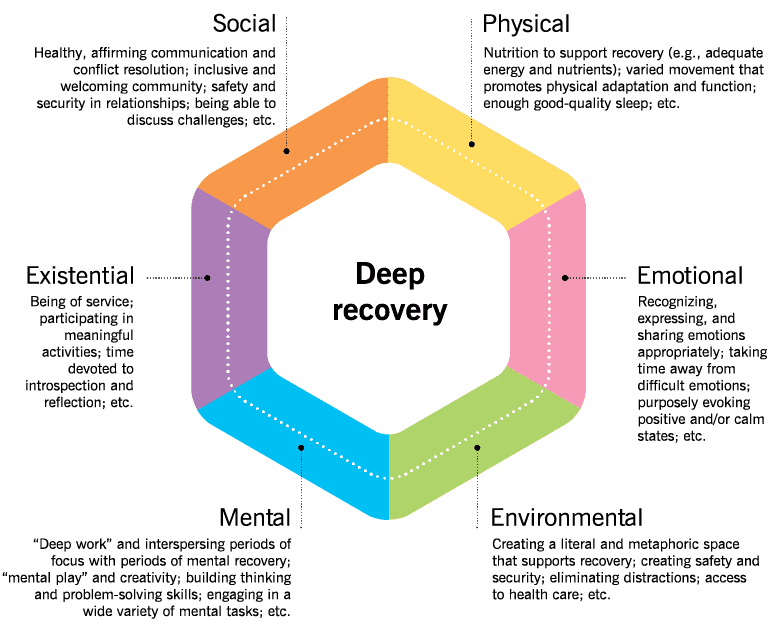
With burnout, the psychological, emotional, and existential items are significantly essential. Nevertheless, many individuals may expertise these as bodily points too. For example, you may not consciously really feel offended… however your jaw muscle tissues are grinding like a wooden chipper. You may not consciously really feel hopeless… you simply really feel exhausted.
Having knowledgeable as an ally to work via these areas—particularly one you like who you are feeling understands you—can assist you get higher outcomes and really feel much less alone.
Contemplate reaching out to your main care doctor or a therapist (or encouraging shoppers struggling to take action).
And keep in mind:
Asking for assist is an indication of energy, not weak spot. (Even The Rock wants a spotter when he benches 900 kilos.)
References
Click on right here to view the data sources referenced on this article.
In case you’re a well being and health coach…
Studying how one can assist shoppers handle stress, construct resilience, and optimize sleep and restoration will be deeply transformative—for each of you.
It helps shoppers get “unstuck” and makes all the things else simpler—whether or not they wish to eat higher, transfer extra, reduce weight, or reclaim their well being.
And for coaches: It offers you a rarified talent that can set you aside as an elite change maker.
The brand-new PN Stage 1 Sleep, Stress Administration, and Restoration Teaching Certification will present you the way.
Need to know extra?
