


Oftentimes, the best methodology is the best methodology.
That’s one of many massive causes we normally recommend our hand portion method to shoppers who need to pay attention to how a lot they’re consuming to lose or achieve weight, and/or to enhance their well being.
You could be questioning: If it’s so easy, why publish an FAQ?!
Nicely, although our hand portion methodology has been validated by means of our expertise with over 100,000 shoppers, no meals monitoring system is ideal.
Like every other methodology of meals monitoring, questions are sure to come back up when you (or your shoppers) begin utilizing hand parts.
So that will help you grasp the system, we’ve put collectively this “helpful” information.
It consists of solutions to all probably the most urgent hand-portion questions our coaches obtain—plus some you (or your shoppers) won’t have even considered but.
Use the hyperlinks under to leap on to the solutions you’re in search of, or give the entire FAQ a learn to learn to troubleshoot the most typical points forward of time. Query #1:
Query #1: “How do I explain hand portions to my clients?!”
Query #2: “How accurate are hand portions?”
Query #3: “How many hand portions should I eat?”
Query #4: “Can I do hand portions with Paleo, keto, plant-based eating, and other diets?”
Query #5: “Do I gauge my portions before or after cooking?”
Query #6: “How do I handle foods that don’t fit?”
Query #7: “How do I account for mixed-food meals?”
Query #8: “Are legumes and lentils protein or carbs?”
Query #9: “What do I do when I’m not seeing results with hand portions?”
Query #10: “How do I get skeptical clients on board with trying hand portions?”
Bonus Query: “Okay, but are there times when hand portions aren’t appropriate?”
++++
10 widespread hand-portion questions, answered
Query #1: “How do I clarify hand parts to my shoppers?!”
Maintain it brief and candy.
We’d recommend beginning with one thing like:
You utilize your hand as a personalised, moveable portioning instrument.
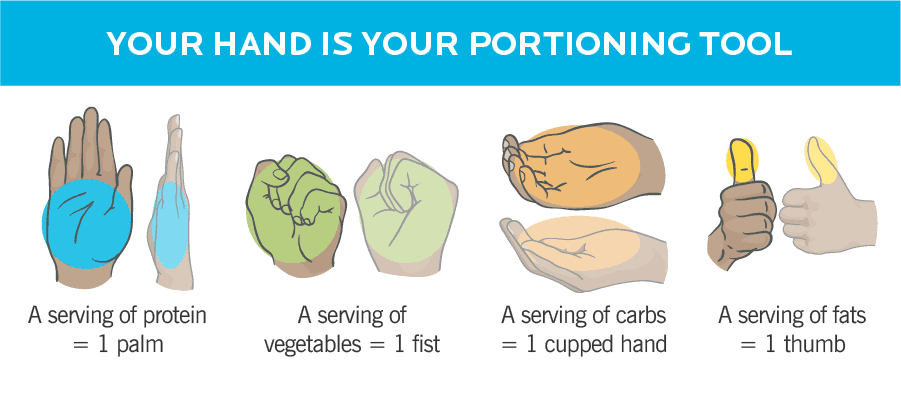
You’re not really measuring your meals, however reasonably utilizing your hand to gauge portion measurement. The next picture sums it up properly (and yow will discover a more detailed infographic here.)
There are fairly a couple of benefits to the system. Two we’d advocate mentioning proper off the bat:
#1: Your palms are with you in all places you go. This implies you’ve a constant reference level wherever you might be—on the airport, your mother’s home, work lunches, buffet eating places, and extra. (It additionally means you don’t need to take heed to your desk mates groan as you furiously seek for calorie counts in your meals monitoring app.)
#2: Your palms are typically proportional to your physique and at all times the identical measurement. In order that they function a dependable reference level—with out the necessity for measuring cups or a meals scale. (No must surprise in case your scale’s batteries are dying, or sheepishly pull your measuring cups out of your bag at your pal’s birthday dinner.)
From there, you’ll be able to deal with a shopper’s particular questions or considerations as they arrive up.
Query #2: “How correct are hand parts?”
Our inner calculations present hand parts are about 95 % as correct as fastidiously weighing, measuring, and tracking your food. With considerably much less time and effort concerned.
And since calorie databases—the instrument most individuals use to trace energy and macros—could be off by as a lot as 20 %, the 5 % distinction right here is negligible for many.1
Plus, as every hand portion correlates to a specific amount of protein, carbs, and/or fats, this methodology counts energy and macros for you.
It may assist to see what that may appear to be in real-food phrases, so the tables under present perspective on what we contemplate normal hand portion sizes.
| For Males | |
|---|---|
| 1 palm (protein) | ~4 oz (115 g) cooked meat / tofu, 1 cup Greek yogurt / cottage cheese, 1 scoop protein powder, 2 entire eggs |
| 1 fist (veggies) | ~1 cup non-starchy greens (spinach, carrots, cauliflower, peppers, and so forth.) |
| 1 cupped hand (carbs) | ~⅔ cup (130 g) cooked grains / legumes (rice, lentils, oats, and so forth.), 1 medium fruit, 1 medium tuber (potatoes, yams, and so forth.) |
| 1 thumb (fat) | ~1 tablespoon (14 g) oils, nuts, seeds, nut butters, cheese, darkish chocolate, and so forth. |
| For Girls | |
|---|---|
| 1 palm (protein) | ~3 oz (85 g) cooked meat / tofu, 1 cup Greek yogurt / cottage cheese, 1 scoop protein powder, 2 entire eggs |
| 1 fist (veggies) | ~1 cup non-starchy greens (spinach, carrots, cauliflower, peppers, and so forth.) |
| 1 cupped hand (carbs) | ~½ cup (100 g) cooked grains / legumes (rice, lentils, oats, and so forth.), 1 medium fruit, 1 medium tuber (potatoes, yams, and so forth.) |
| 1 thumb (fats) | ~1 tablespoon (14 g) oils, nuts, seeds, nut butters, cheese, darkish chocolate, and so forth. |
Need to see the maths? That’s completely honest, particularly if you happen to’re a numbers-oriented type of particular person.
Within the tables under, you’ll be able to see what every portion is roughly equal to in grams of protein, carbohydrates, fats, and energy.
Be aware that the hand portion system assumes a blended consumption, that means you’ll eat varied meals sources of every class. In different phrases, it assumes you’ll eat totally different protein sources like hen, eggs, cottage cheese, and tofu for protein, versus residing on hen breast.
Additionally, as you’ll be able to see within the desk under, most meals aren’t purely one macronutrient. That’s okay—the hand portion system accounts for that, too.
| Males’s portion macros | |
|---|---|
| 1 palm protein | ~ 24 g protein, 2 g carbs, 4.5 g fats, 145 kcal |
| 1 fist veggies | ~ 1.5 g protein, 5 g carbs, 0 g fats, 25 kcal |
| 1 cupped hand of carbs | ~ 3 g protein, 25 g carbs, 1 g fats, 120 kcal |
| 1 thumb fat | ~ 2 g protein, 2 g carbs, 9 g fats, 100 kcal |
| Girls’s portion macros | |
|---|---|
| 1 palm protein | ~ 22 g protein, 2 g carbs, 4 g fats, 130 kcal |
| 1 fist veggies | ~ 1.5 g protein, 5 g carbs, 0 g fats, 25 kcal |
| 1 cupped hand of carbs | ~ 3 g protein, 22 g carbs, 1 g fats, 110 kcal |
| 1 thumb fat | ~ 2 g protein, 2 g carbs, 8 g fats, 90 kcal |
Make no mistake: Hand parts aren’t as accurate as macro tracking. However they’re correct sufficient that will help you constantly observe your meals consumption, and attain your targets (together with transforming your body, if that’s what you’re after). And that’s what actually issues.
Query #3: “What number of hand parts ought to I eat every day?”
It relies upon.
There’s no one-size-fits-all suggestion that’ll work for everybody, however we do have some normal tips for individuals who need to attempt it out. Most individuals will meet their wants with a beginning framework of:
- 1-2 palms of protein-dense meals at every meal
- 1-2 fists of greens at every meal
- 1-2 cupped handfuls of carbohydrates at most meals
- 1-2 thumbs of fat-dense meals at most meals
In fact, relying in your targets, chances are you’ll want to regulate these normal suggestions with a purpose to see outcomes.
That’s precisely why we created the Precision Nutrition Calculator.
Designed, developed, and examined within the Precision Vitamin analysis lab—and confirmed efficient with hundreds of shoppers—it’s probably the most complete calorie, portion, and macro calculator accessible.
The calculator takes under consideration:
- Your private particulars (peak, age, weight, intercourse)
- Bodily exercise ranges (each every day motion and purposeful train)
- Vitamin and health targets (weight reduction, muscle achieve, physique recomposition, higher well being, peak efficiency)
- The date you need to attain your objective by (inside motive!)
- The altering and adaptive nature of human metabolism (a significant advantage of this calculator)
Right here’s what’s actually cool:
As soon as it estimates your calorie and macronutrient wants, it robotically converts these numbers into hand parts.
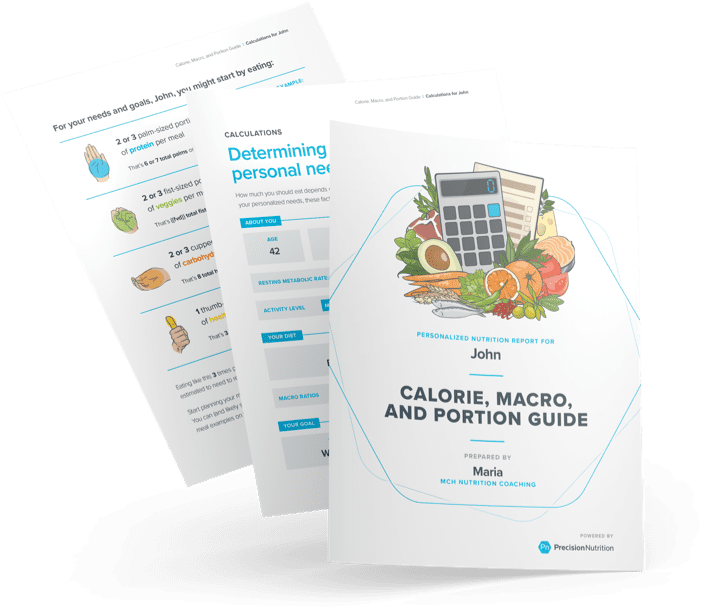
And after these are calculated, we’ll ship you a free, customized information to utilizing our hand portion system for hitting your calorie and macro targets.
Query #4: “Can I do hand parts with Paleo, keto, plant-based consuming, and different diets?”
Regardless of the consuming type, the reply is sort of certainly sure.
In reality, our hand portions calculator provides you the choice of selecting from quite a lot of consuming kinds, together with Mediterranean, Paleo, vegetarian, ketogenic, and totally plant-based. (For those who’ll eat virtually something with no restrictions, there’s an possibility for that, too.)
What’s extra, you’ll be able to modify your macronutrient cut up—that’s, your relative proportions of protein, carbohydrates, and fat—earlier than you get your outcomes.
So if you happen to’re not into keto (<10 % carbs), however you favor to eat lower-carb, you’ll be able to modify your hand parts to account for that. Identical goes if you happen to desire a low-fat weight-reduction plan, or when you’ve got every other choice about your macronutrient ratio.
The low-tech approach to do that is to easily exchange one portion for an additional. For example, let’s say you favor a low-fat weight-reduction plan, and also you eat 4 meals a day. At two of your meals, you would possibly nix the thumb of fat, as an alternative including an additional palm of protein, or an additional cupped handful of carbs. (You might additionally cut up the additional portion between the protein and carbs.)
The underside line: The hand parts system is endlessly adaptable to quite a lot of consuming kinds, with nearly no math required.
Query #5: “Do I gauge my parts earlier than or after cooking?”
One of the widespread questions requested about utilizing your palms to measure parts is whether or not the hand parts are for cooked or raw meals.
The reply is each.
Hand parts are for plating your meals, not cooking it. For meals you eat cooked, you gauge them as soon as cooked (e.g., meat, pasta, rice). For meals you eat uncooked, you gauge them uncooked.
And if a meals could be eaten each cooked or uncooked (corresponding to spinach, for instance) then you definately would use your hand to gauge the quantity that’s going onto your plate, whether or not you cooked it or not. (Whereas there’s a calorie distinction between the cooked and raw model, that solely actually issues for folk with probably the most superior aesthetic targets, corresponding to bodybuilders).
That approach, hand parts can be utilized wherever: dwelling, eating places, buffets, conferences, at a pal’s home, the workplace.
Query #6: “How do I deal with meals that don’t match completely right into a class?”
Most meals clearly match into the hand portion classes: protein, carbohydrates, fats, and greens. (For those who’re unsure a few sure meals, this infographic will provide answers.)
However some meals and drinks don’t appear to be they match nicely into the hand-size portion system.
The excellent news: There are workarounds.
Most notably problematic are liquids and meals constituted of a number of components (versus entire meals).
Right here’s tips on how to deal with them. And no, you don’t need to pour drinks into your cupped hand to measure them!
Dairy
Cow’s milk, non-Greek yogurt, and kefir are difficult as they’re a fairly even mixture of protein, carbohydrates, and fats, or can range relying on the fats degree you select (as an example, entire, low fats, skim).
We advise making the choice of tips on how to depend a particular sort of milk or yogurt based mostly on the fats or carbohydrate content material.
- Typically, contemplate 1 cup (8 ounces) of entire milk merchandise a “thumb” of fats. (Sure, although it’s bigger than a thumb and likewise supplies some protein and carbs.)
- Something decrease in fats (0 to 2 %) is mostly thought-about a cupped hand of carbs (whereas additionally offering some fat and protein).
- A cup of something highly-sweetened (chocolate milk, strawberry yogurt) is mostly thought-about a cupped hand of carbs (whereas additionally offering fat and protein).
So what occurs on this state of affairs: You have got a full-fat yogurt or entire milk that’s extremely sweetened? Is it a fats or carb?
Consider it this manner: If it’s already full-fat, you understand it’s a thumb of fats. But when quite a lot of sugar can also be added to it, then it’s additionally a cupped hand of carbs.
The important thing right here is to select an method, and apply it constantly. For most individuals, that is most likely extra essential than the precise classification itself.
That’s as a result of the hand portion system already has built-in buffers: It assumes your protein, fats, and carb sources comprise smaller quantities of the opposite macros.
What’s extra, if you happen to’re according to the way you gauge meals, you’ll be able to extra simply modify based mostly on the outcomes you’re getting.
Plant milks
Plant milks are very like cow’s milk above. They have an inclination to offer a mixture of macros, relying on the supply, and classification would additionally rely upon whether or not or not they’re sweetened.
Typically, unsweetened variations (like plain almond milk) don’t depend as something, as they usually solely have about 30 to 40 energy in an entire cup (8 ounces), and are sometimes consumed in comparatively small quantities.
A sweetened model, nonetheless, can be thought-about a cupped hand of carbs.
Once more, the hot button is to select an method and observe it constantly.
Eggs
Eggs are thought-about a protein, however as a result of they’re liquid of their uncooked type, individuals are typically not sure about tips on how to measure them.
Typically, two cooked entire eggs are the dimensions of a palm. 4 cooked egg whites are additionally the dimensions of a median palm.
In fact, precise quantities could range based mostly on the dimensions of your particular person palm.
One query we’ve gotten about eggs: Why do two eggs depend as a palm of protein after they solely have about 6 grams of protein every? (So 12 grams of protein in whole.)
It’s an excellent query. First, it’s essential to recollect:
With hand parts, we’re utilizing our palms to gauge the portion measurement. We’re not reverse-engineering the parts based mostly on what number of macros are in a given meals.
2 eggs are the dimensions of a median palm, which is why they’re counted as one palm of protein.
For those who’re questioning how this impacts your whole protein consumption, the reply goes again to the concept of assuming a blended consumption of quite a lot of totally different protein sources.
Total, we estimate that every palm of protein is roughly 20 to 30 grams of protein. It’s true two eggs present much less protein than, say, a palm of hen breast. However… a palm of hen breast is definitely above that 20- to 30-gram vary.
The concept: Most sources—however not all—will land in that 20- to 30-gram vary. And the common of all of the totally different protein sources you eat will definitely find yourself in that vary, even when there are some particular person exceptions (like eggs and hen breast).
Cookies, ice cream, chips (and different compound meals)
With naturally-occurring or minimally-processed meals, it’s normally greatest to assign just one hand portion to a meals.
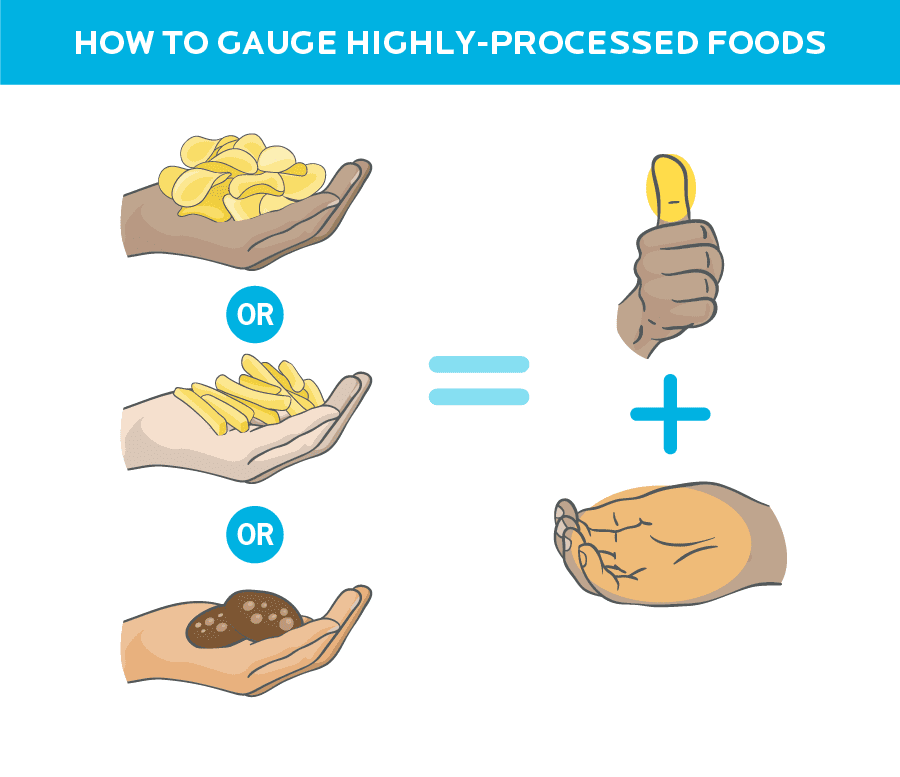
However with these highly-processed “compound” meals, you’ll need to assign two (or extra) hand parts. As a result of similar to dairy merchandise which might be full-fat and extremely sweetened, they depend as each fats and carbs.
Right here’s a straightforward technique to account for highly-processed and compound meals: one handful is the same as one thumb of fats and one cupped hand of carbs.
Soda and juice
Sadly, a serving of soda doesn’t actually match right into a cupped hand. Regardless, contemplate a 12-ounce can of non-diet soda as one cupped hand of carbs.
Actually, eight ounces can be preferable from the standpoint of bodily measurement (and carbohydrate whole), however 12 ounces actually simplifies the method, as these drinks most frequently come pre-packaged this manner.
(That is much like how we account for bananas, apples, oranges, pears, and different fruits of various sizes, since they’re “pre-packaged” by nature.)
Once more, the consistency of the way you gauge your hand parts is definitely an important issue.
As for juice, contemplate an 8-ounce glass of juice to be one cupped hand of carbs.
Alcohol
In some ways, alcohol must be its personal portion class, because the overwhelming majority of its energy are derived from its alcohol content material (7 kcal/gram), not its carb, protein or fats content material.
This is applicable to just about all alcohol, be it mild beer, microbrew/craft beer, wine, arduous ciders, and spirits.
A “serving” of alcohol is about 5 ounces for wine, 1 ounce for spirits (instance: vodka, whiskey, tequila), and 12 ounces for beer.
Nevertheless, with the rise of craft beers, corresponding to double IPAs which have a lot greater alcohol content material than “common” beer, the usual “beer serving” doesn’t maintain up in addition to it as soon as did.
Most “common” beer is about 4 to five % alcohol by quantity (ABV). Many craft beers could be as excessive as 9 % ABV, some even reaching 15 to twenty % ABV.
And since alcohol itself supplies energy (once more, 7 kcal/gram), doubling or tripling the alcohol content material dramatically will increase the calorie content material.
Moreover, many craft beers have greater quantities of carbs than “common” beers. The quantity of carbs in a beer will depend on the way it’s made.
If the beer has a thicker mouthfeel, darker look, and sweeter taste, it’s going to most certainly have extra carbs. The quantity of carbs in a 12 ounce “serving” of beer ranges from 2 to 16 grams. Plus, many craft beers are available 16 ounce sizes, or pints, which implies they’re 33 % bigger, and thus present 33 % extra alcohol, carbs, and energy.
Is your head spinning but? Don’t overcomplicate. Like we stated, easier is best.
So…
For hand portion functions, we advocate counting them as follows:
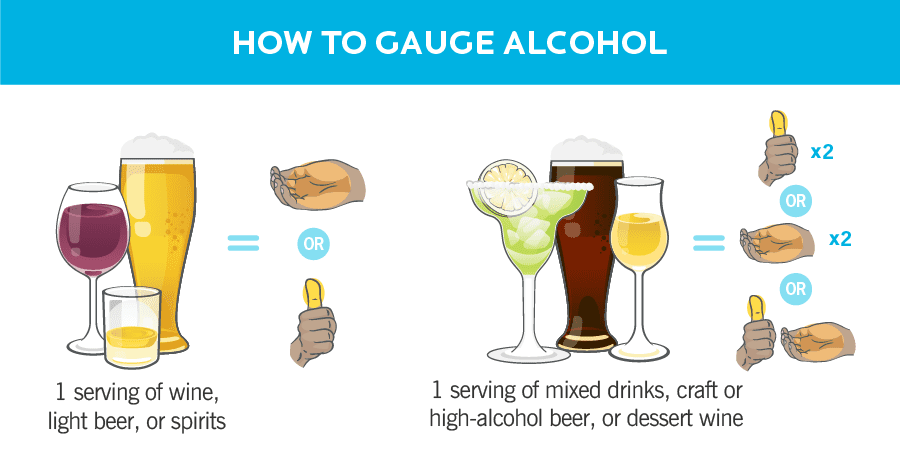
- A serving of wine, spirits or “common” beer counts as one cupped hand of carbs or 1 thumb of fats.
- A serving of dessert wine, sweetened spirit (e.g. gin and tonic, margarita), or sweeter/high-alcohol/craft beer counts as two parts—both 2 cupped palms of carbs, 2 thumbs of fats, or 1 of every.
One final notice on alcohol: When you can depend your alcohol consumption with hand parts, it’s nonetheless essential to be aware of your general variety of drinks. (You’ll be able to be taught extra right here about how all drinking comes with potential health effects.)
Query #7: “How do I depend parts for mixed-food meals?”
Dishes comprised of a giant mixture of meals, corresponding to soups and stews, could make it difficult to assign hand parts (simply as they make it troublesome if you happen to’re monitoring macros or energy).
You merely need to eyeball it, and make your greatest guess, particularly if you happen to didn’t make the meal your self.
In the end, the final objective is to get a portion of protein, veggies, high quality carbs, and/or wholesome fat in every serving. That is comparatively straightforward to do when cooking for your self. When consuming meals made by others, merely guesstimate in addition to you’ll be able to.
Most significantly, if the objective is something apart from weight achieve, eat slowly and mindfully, till happy.
Usually, mixed-food meals like this are a mixture of protein, carbs, and fat, however are a bit decrease in veggies. Including a vegetable on the facet could be very useful. And including extra protein may also be useful if the meal appears to have a better proportion of carbs and fat (which they typically do).
One factor to recollect right here: For meals you’ve typically, “set it and overlook it.” That means, set up the way you’ll gauge the hand parts, and constantly observe that method. That approach, if you happen to ever need to modify your consumption, you’ll know tips on how to depend the hand parts. (For those who resolve to eat half the standard quantity of a soup, you’d then solely depend half the standard hand parts.)
Query #8: “Ought to I depend legumes and lentils as protein or carbs?”
Legumes and lentils contain both protein and carbs, so the place ought to they be counted?
Reply: It will depend on the meal itself and/or the consuming type of the person.
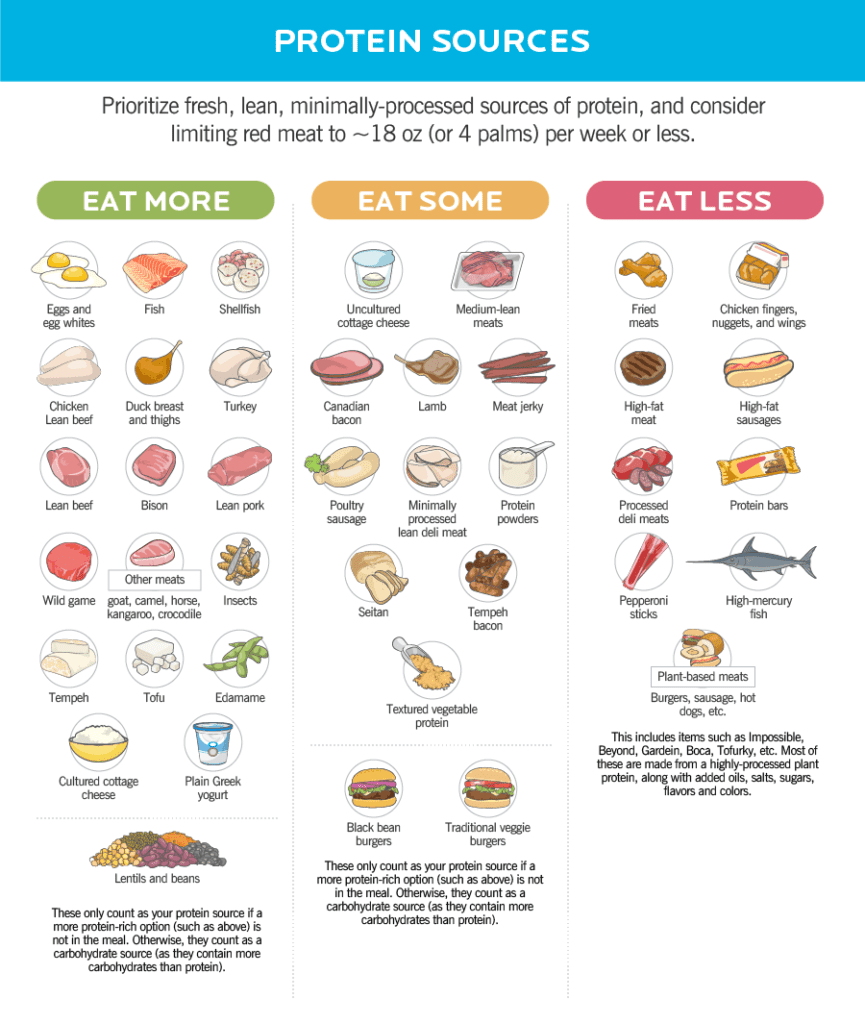
If somebody is fully plant-based/vegan, then it’s seemingly the legumes or lentils will depend as their protein supply, since these are most likely probably the most protein-dense meals they’re consuming in a given meal.
For many different eaters, beans and legumes would typically depend as a carb supply, since they’re far richer in carbs than protein.
However they will additionally depend as each… beneath sure situations.
Our suggestion: Select probably the most protein-rich meals (assuming there’s one) as your protein supply, and slot the opposite gadgets from there.
Examples:
- Rooster with beans, broccoli and olive oil
- Beans with rice, broccoli and olive oil
- Two parts of beans with broccoli and olive oil
- One portion of beans with broccoli and olive oil
In instance 1, hen is the protein (probably the most protein-rich a part of the dish), beans are the carbs, broccoli is the vegetable, and olive oil is the fats.
In instance 2, beans are the protein (probably the most protein-rich a part of the dish), rice is the carb, broccoli is the vegetable, and olive oil is the fats.
In instance 3, one serving of beans would depend as protein, and the opposite serving would depend as carbs. On this situation, it will get harder as a result of it’s much less clear-cut than the primary two examples.
In instance 4, it could rely upon the eater. Omnivore? Then we’d seemingly depend the beans as a carb. Plant-based? Then we’d seemingly depend the beans as a protein.
Query #9: “What do I do once I’m not seeing outcomes with hand parts?”
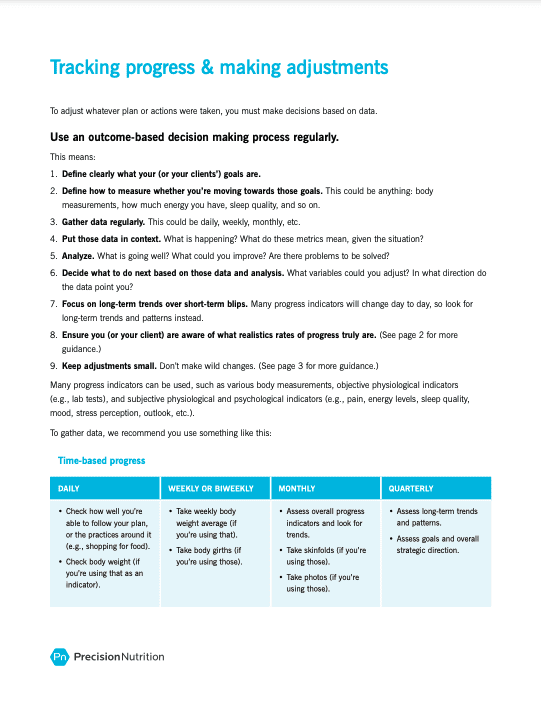
You’ll be able to at all times contemplate tweaking your hand parts, however earlier than you do this it may be useful to grasp real looking charges of progress.
Follow a constant variety of hand parts for at the very least two weeks and monitor your progress earlier than making an attempt to change issues up. This enables sufficient time to find out whether or not you’re getting nearer to your objective—or not.
In case your objective is fats loss…
How briskly you’ll be able to lose physique fats will depend on how constantly you’ll be able to, or need to, observe the rules you’re given.
Lifelike charges of fats loss per week
| Progress | % Physique Weight | Males | Girls |
|---|---|---|---|
| Excessive | 1-1.5% physique weight | ~2-3 lb (0.91-1.36 kg) | ~1.65-2.5 lb (0.75-1.13 kg) |
| Affordable | 0.5-1% physique weight | ~1-2 lb (0.45-0.91 kg) | ~0.8-1.65 lb (0.36-0.75 kg) |
| Comfy | <0.5% physique weight | ~<1 lb (0.45 kg) | ~<0.8 lb (0.36 kg) |
Right here’s tips on how to quantify every of those classes:
Excessive: Requires about 90 to 100% consistency.
Affordable: Requires about 70 to 85 % consistency.
Comfy: Requires about 50 to 65 % consistency.
Clearly, the extra constant you might be, the quicker your progress, and the extra fats chances are you’ll lose.
It’s additionally essential to comprehend that fats loss isn’t linear. It fluctuates from everyday and week to week. The objective is to see an general development downward over time.
However if you happen to’re not seeing that development…
You’ll be able to modify your hand parts by eradicating 1 to 2 cupped handfuls of carbs and/or 1 to 2 thumbs of fat out of your every day consumption. (That’s 2 to three whole parts of carbs and fat, mixed.) This works out to consuming about 250 energy much less per day.
In case your objective is muscle achieve…
The power to achieve muscle relies on age, organic intercourse, genetics, and consistency with meals consumption, together with resistance coaching expertise, depth, frequency, type, quantity, and extra.
Lifelike charges of muscle achieve monthly
| Health degree | Males | Girls | ||
|---|---|---|---|---|
| Newbie | 1-1.5% physique weight | ~1.5-2.5 lb (0.68-1.13 kg) | 0.5-0.75% physique weight | ~0.65-1 lb (0.29-0.45 kg) |
| Intermediate | 0.5-0.75% physique weight | ~0.75-1.25 lb (0.34-0.56 kg) | 0.25-0.375% physique weight | ~0.325-0.5 lb (0.14-0.23 kg) |
| Superior | 0.25-0.375% physique weight | ~0.375-0.625 lb (0.17-.28 kg) | 0.125-0.1875% physique weight | ~0.1625-0.25 lb (0.07-0.11 kg) |
Very similar to fats loss, muscle achieve is commonly not linear. Progress appears to come back in suits and spurts, particularly after the primary yr of devoted coaching.
However if you happen to’re not gaining muscle as anticipated…
Merely add 1 to 2 cupped handfuls of carbs and/or 1 to 2 thumbs of fat to your every day consumption. (Once more, that’s 2 to three whole parts of carbs and fat, mixed.) This works out to a rise of about 250 energy a day.
Need to be taught extra? Right here’s a deep dive into how to adjust your portions when you’re not seeing progress, plus a nifty downloadable reference guide on tips on how to tweak your consumption to get higher outcomes.
Query #10: “How do I get skeptical shoppers on board with making an attempt hand parts?”
For those who’re a coach, you could have shoppers used to counting energy and/or macros, who don’t consider that hand parts may presumably ship the identical outcomes.
However, you may need shoppers who don’t depend something, preferring a extra intuitive methodology as an alternative.
There’s nothing incorrect with both of those approaches. (Right here’s extra information on how hand portions, macro counting, calorie counting and intuitive eating compare.)
However when a shopper isn’t seeing the outcomes they’re in search of with their present meals consumption monitoring methodology, you may need a hunch that hand parts may assist.
So how do you assist hand-portion skeptics?
Deal with utilizing hand parts as an experiment.
Self-experimentation is among the cornerstones of our very personal teaching program. (Be taught extra: 3 diet experiments that can change your eating habits.)
Why? It takes away the strain to make a “good” vitamin alternative. For those who experiment with one thing and it doesn’t work out—no massive deal. You’re one step nearer to determining what works for you by means of elimination.
And greatest case situation? You discover one thing that actually does be just right for you.
So in case your shopper is prepared to check out hand parts for 2 weeks, make it an experiment.
Encourage them to assemble their knowledge concerning the expertise like a scientist, with out judgement.
On the finish of the 2 weeks, test in to see how the experiment went, and resolve the way you’ll transfer ahead collectively.
We discover that hand parts work for a lot of (if not most!) of our shoppers as soon as they struggle them. However be open to the concept that your shopper should still really feel unsure about hand parts after their experiment is completed. That’s okay.
Each particular person is totally different, and also you by no means know precisely how a specific approach of consuming goes to work till you attempt.
Bonus query: “Okay, however are there instances when hand parts aren’t applicable?”
Individuals who need to eat, transfer, and reside higher normally do nicely with hand parts. They’re handy, straightforward to grasp, and extremely customizable with little or no effort concerned.
Nevertheless it’d be incorrect to say that hand parts are hands-down the very best method for everybody.
Completely different methods work for various kinds of targets. In the end, whether or not you select to make use of hand parts, PN’s plate method, macro counting, nutrient timing protocols, or every other dietary instrument will depend on what you hope to realize, or the “job to be finished.”
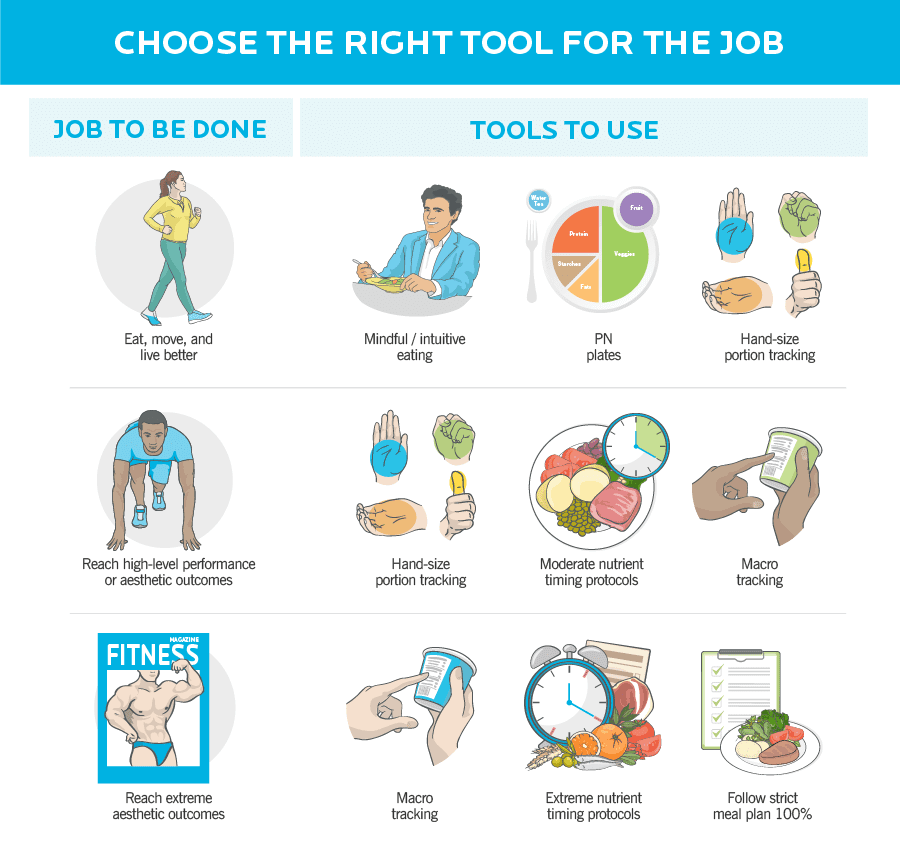
Particularly, hand parts will not be the fitting method for individuals who have probably the most aggressive aesthetic and efficiency targets.
For example, skilled athletes and physique fashions might have a extra exact technique, corresponding to macro counting or perhaps a strict meal plan. It’s the identical with athletes who want to chop weight or attain a particular physique fats proportion—corresponding to in preparation for a UFC combat.
Consider: These individuals are primarily being paid to eat this manner. It’s a part of their job. And that comes with tradeoffs.
(For those who’re questioning what these tradeoffs would possibly appear to be, take a look at our useful resource on the cost of getting lean.)
There may even be some individuals who attempt hand parts and easily don’t like them.
For instance, individuals who love numbers and knowledge would possibly discover monitoring macros and energy together with physique modifications empowering. These of us are additionally normally emotionally indifferent from the numbers—seeing them as info reasonably than assigning them “good” or “dangerous” values.
These individuals would possibly experiment with hand parts, as described above, and say, “Nah, I’m good.” That’s legitimate.
It actually comes right down to this:
Hand parts work for lots of—if not most—individuals. However there are at all times exceptions, as a result of there’s no single greatest technique to eat.
References
Click on right here to view the knowledge sources referenced on this article.
For those who’re a coach, otherwise you need to be…
Studying tips on how to coach shoppers, sufferers, associates, or relations by means of wholesome consuming and life-style modifications—in a approach that’s customized for his or her distinctive physique, preferences, and circumstances—is each an artwork and a science.
For those who’d prefer to be taught extra about each, contemplate the Precision Nutrition Level 1 Certification. The following group kicks off shortly.
